
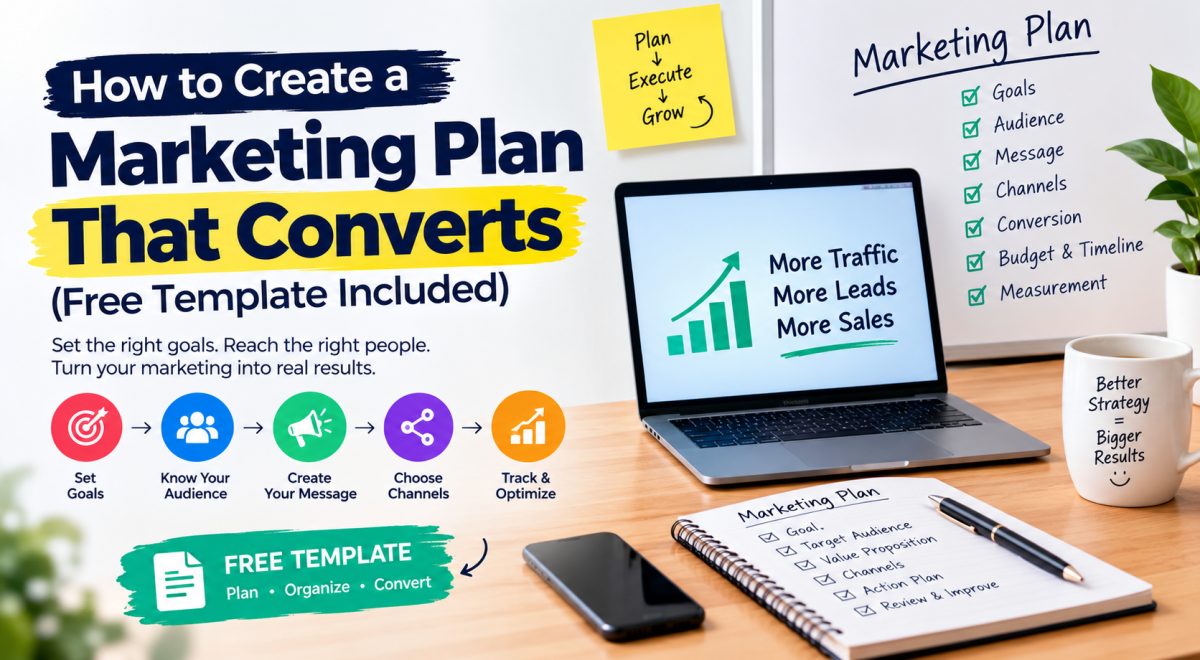
How to Create a Marketing Plan That Converts (Free Template Included)
A marketing plan isn’t a posting schedule. Its job is to get the right people to your business, then get them to do something: buy, book a call, join your email list, or ask for a quote.
Plenty of small businesses skip that second part. They post three times a week and still don’t sell anything. They spend money on ads and can’t say which campaign brought in a customer. Visitors land on the website, look around, and leave.
A plan that converts ties together who you’re talking to, what you’re offering, what you’re saying, where you’re saying it, and what happens next. It also gives you a way to check whether any of it is working.
This guide walks through how to build one, how to measure it, and how to use the free template for your own business.
What is a marketing plan that converts?
It’s a written plan for how you’ll reach potential customers, explain what your offer is worth to them, and get them to take one specific action.
That action depends on what you sell. An online store wants completed purchases. A freelancer wants inquiries from people who might actually hire them. A blogger wants email subscribers. An affiliate marketer wants readers to click through to a product and buy it.
A useful plan usually includes:
- A specific goal and a way to track progress
- A clearly defined target audience
- An offer that solves a real customer problem
- Messages that explain what the offer is worth
- Channels for reaching potential customers
- A conversion path that makes the next step easy
- A budget, a timeline, and a regular review
The U.S. Small Business Administration advises tying your marketing and sales strategies together, covering how you attract customers, keep them, and close sales. That means your plan has to cover what happens after someone finds you, not only how they find you.
1. Set a clear marketing goal

Decide what you want your marketing to accomplish before you pick channels or set a budget. Without a goal, you can’t tell whether anything is working.
“Get more customers” and “grow my brand” aren’t goals. They’re wishes. A real goal has a result and a deadline:
- Go from 20 qualified sales inquiries a month to 35 within 90 days.
- Add 50 new email subscribers a month for the next three months.
- Raise online purchases from 15 to 25 a month without going over your ad budget.
- Increase the share of landing-page visitors who complete the signup form.
These numbers are made up for illustration. They aren’t industry benchmarks. Base your own targets on where you are now, what you can spend, and how your business works.
Pick the right metric
Your main metric should match your goal.
| Marketing goal | Metric to track |
| Generate leads | Qualified leads received |
| Increase sales | Completed purchases or revenue |
| Grow an email list | New subscribers |
| Improve a landing page | Conversion rate |
| Increase profitability | Profit after relevant marketing costs |
| Build brand awareness | Relevant reach, branded searches, or qualified traffic |
Conversion rate is simple to calculate:
Conversion rate = (conversions ÷ total visitors) × 100
If 500 people visit a landing page and 25 subscribe, your conversion rate is 5%.
Keep the denominator consistent. A website conversion rate is based on visitors, an email conversion rate on delivered emails, and a sales conversion rate on qualified leads. Comparing one against another gives you nonsense.
Also remember that conversions aren’t equal. Fifty people who grabbed a free download may be worth less than ten who are actually ready to pay.
2. Understand your target audience
The better you know who needs your product and what’s holding them back, the easier everything else gets. Start with four questions:
- Who is most likely to benefit from what you offer?
- What problem are they trying to solve?
- What are they using instead right now?
- What worries might stop them from buying?
Be specific. “People interested in business” tells you nothing if you sell an email marketing service. “Solo business owners who’ve started collecting email subscribers but can’t turn them into customers” tells you what to write about, what to offer, and which problem to name in your headline.
Use research, not guesses
You don’t need an expensive study. You can:
- Write down the questions customers ask before they buy
- Read product reviews and note the complaints that keep coming up
- Interview a few existing customers about why they picked you
- Go through support messages and sales objections
- Check search queries and website behavior, if you have reliable data
Look for patterns, not one person’s opinion. If several customers say your product is hard to set up, that’s your cue to build a setup guide, record a walkthrough, or promote your onboarding help.
3. Analyze competitors and define your value proposition

Nobody evaluates your business in a vacuum. Customers compare you with other providers, big brands, free options, and the choice to do nothing. Your plan needs to say why the right customer would pick you.
The SBA recommends looking at competitors’ strengths, weaknesses, and market position to find where you can serve customers differently. Pick two or three competitors and compare:
- Who they sell to
- What they sell
- Their prices and packages
- Which benefits they push in their marketing
- What their reviews praise and complain about
- Gaps you could realistically fill
Don’t copy a competitor’s wording just because it seems to work for them. Look for needs they’re missing and that you can credibly meet.
Write a value proposition
A value proposition says who you help, what result you offer, and why your approach works. Here’s a simple template:
“For [target audience], our [product or service] helps [desired outcome] through [specific benefit or approach].”
A hypothetical example: “For independent online store owners, our email service organizes customer follow-ups with ready-made automation templates, so you spend less time sending emails by hand.”
Compare that with “We provide innovative marketing solutions,” which could describe any company on earth.
Only promise what you can deliver. If you can’t show that your service saves time or raises revenue, describe the features and support you offer and leave the result out.
4. Build an offer that gives people a reason to act
Good targeting won’t save an offer that’s confusing, irrelevant, or hard to evaluate.
Your offer is more than the product. It includes the price, features, terms, delivery, support, any guarantee, and the step someone has to take to buy. Before you launch a campaign, check:
- Does it solve the problem your audience actually cares about?
- Is the benefit easy to understand?
- Are the price and commitment clear?
- Have you answered the usual worries?
- Is there enough information to make a decision?
For a service business, the offer might be a clearly priced intro consultation. For a blogger, a free worksheet. For an online store, a bundle of items that make sense together.
Discounts aren’t always the answer. They cut your profit, attract people who only buy when prices drop, and can make a premium product look cheaper than it is. Before lowering your price, ask whether better product information, stronger proof, an easier checkout, or clearer terms would fix the real problem.
5. Choose channels that match your audience
You don’t have to be everywhere. Pick channels based on where your audience looks for answers, how they make decisions, and how much time and money you can put in consistently.
Search and content marketing.
Works well when people research problems, compare options, or search for solutions. Articles, comparison guides, tutorials, and focused landing pages can bring in the right visitors over time. It’s slow, and rankings are never guaranteed.
Social media.
Good for educational posts, demonstrations, visual guides, and product ideas. Choose platforms that suit your audience and the format you can make well, not whatever is trending this month.
Email marketing.
Best for following up with people who’ve asked to hear from you. Newsletters, onboarding emails, product education, and relevant offers can move subscribers toward a purchase.
Paid advertising.
Makes sense when you can define your audience, test an offer, track results, and afford to experiment. Traffic arrives fast, but spending money doesn’t guarantee profitable sales.
If your resources are limited, start with one main channel and one supporting channel. A blog might lean on search traffic while building an email list. A local service provider might focus on local search and direct inquiries.
Add a channel when you have a real reason to, not because a competitor is on it.
6. Design a simple conversion path
A conversion path is the series of steps someone takes between first hearing about you and doing what you want them to do. Here’s what a typical one looks like:
- Discovery. They find you through a search result, a social post, a referral, or an ad.
- Interest. They land on a useful article, a product page, or a landing page.
- Decision. They weigh the benefits, look for proof, check the price, and want their objections answered.
- Conversion. They buy, sign up, book, or send a real inquiry.
- Follow-up. They get onboarding, support, and a reason to come back or buy again.
Each step needs its own job. Someone reading an educational article probably isn’t ready to buy yet, so a related checklist or an email signup is a better next step. Someone on a product page who clearly wants to buy just needs a purchase button.
Make the next step obvious
Write calls to action that say what happens when the person clicks, like “Download the Free Budget Planner,” “Book a Consultation,” or “View Pricing.” Vague buttons such as “Learn More” leave people guessing.
Don’t give visitors too many choices, either. If a page has four equally loud buttons, people often pick none of them.
Then check the boring details. Click every button. Submit your own forms. Make sure the confirmation message shows up, and that the page people land on matches what the ad or post promised.
If lots of people visit but few act, don’t buy more traffic yet. Look at the offer, the page copy, whether visitors have a reason to trust you, how long the form is, and whether something is technically broken. More visitors will only repeat the same leak.
7. Write messages that answer customer concerns
A good message connects a problem your audience already feels to something your offer does about it. It also gives people enough information to decide whether the offer fits them.
Here’s a simple structure:
- Problem. Name something your audience recognizes.
- Benefit. Say what your offer helps them do.
- Evidence. Show proof: a demo, a real testimonial, a clear explanation of the features, or a documented result.
- Action. Tell them what to do next.
A hypothetical example for an email marketing service:
- Problem: You’ve got email subscribers, but hardly any of them come back to your store.
- Benefit: Build a follow-up sequence that introduces useful products and answers the questions buyers usually have.
- Evidence: Here’s a sample sequence, with a note on what each email is for.
- Action: Explore the email sequence template.
Notice what the example doesn’t say. It never claims the sequence will raise your sales. It shows what you’d get and lets the reader judge.
Match the message to the customer’s stage
Someone who’s never heard of you needs a different message from someone who’s already compared three of your competitors.
| Customer stage | Best approach |
| Awareness | Explain the problem and share useful information |
| Consideration | Compare options, show the benefits, answer questions |
| Decision | Spell out pricing, terms, product details, and how buying works |
| After purchase | Help them get started and use the product |
Get this wrong and you end up pitching a sale to someone who’s still trying to figure out what their problem is.
8. Set a realistic marketing budget
Base your budget on what the business can afford, what the plan needs to run, and what a customer is worth to you.
You don’t have to spend much to begin. A small business can start with free educational content, the free tier of an email platform, and basic analytics, then decide later whether paid ads are worth it.
Write down everything the plan will cost:
- Advertising and promotion
- Website hosting and marketing software
- Content, photography, or design
- Freelancers or other outside help
- Email and customer management tools
- Testing and other campaign expenses
Count your own time too. A campaign that costs nothing in cash can still eat 15 hours a week.
Work out what a customer is worth to you
Say a service brings in $120 from a new customer. After the direct cost of delivering it, $70 is left before marketing and overhead.
If you spend $60 to win that customer, you’re left with $10 before other overhead. If you spend $80, you’ve lost money on the sale.
That doesn’t mean every customer has to pay off on the first purchase. Repeat buyers can change the math. But if you’re counting on future revenue, have a reasonable basis for it instead of hoping.
When you can measure it, track customer acquisition cost (CAC):
CAC = acquisition costs ÷ new customers acquired
Decide which costs go in and stick with that method. If one month counts only ad spend and the next counts ads, labor, and software, you can’t compare them.
9. Measure performance and improve the plan
Review your plan on a regular schedule. Your first version is a best guess about which audience, message, offer, and channel will work. Treat it like one.
Look at results at every stage, not just the final sales number. A campaign might get plenty of clicks and almost no inquiries. That could mean the ad doesn’t match the landing page, the targeting is off, the offer is unclear, or the form is annoying to fill out.
This table gives you a starting point:
| What you see | What to look into |
| Few people see your content | Distribution, targeting, search visibility, reach |
| People see it but rarely click | Relevance, headline, creative, audience fit |
| People click but leave fast | Page relevance, loading problems, mismatched expectations |
| People engage but don’t inquire | Offer clarity, trust, price, missing information |
| People inquire but don’t buy | Lead quality, follow-up, objections, pricing |
| Sales come in but profit is thin | Acquisition cost, margins, refunds, delivery costs |
These are places to look, not verdicts. Confirm the cause with real customer feedback and reliable analytics.
Test one change at a time
If you change the headline, price, audience, landing page, and button all in the same week, you won’t know which one moved the numbers.
Pick one change, based on your strongest evidence. If customers keep asking what a service includes, spell out the deliverables on the landing page and see whether qualified inquiries go up.
Give the test enough time and enough data. Small samples bounce around a lot, and a good week doesn’t prove the change will keep working.
Keep a simple log: what you changed, when, what happened, and what you’ll try next.
Free marketing plan template
Copy this into Google Docs, Word, Notion, or a spreadsheet and fill in each line.
Marketing plan worksheet
For small businesses, blogs, freelancers, and online stores
- Business or project name:
- Main marketing goal:
- Target audience:
- Customer problem:
- Main offer and value proposition:
- Primary marketing channel (pick one): SEO and content marketing / Social media and Pinterest / Email marketing / Paid advertising / Local marketing and referrals
- Desired customer action:
- Available marketing budget:
- Main performance metric:
- Planning period (pick one): 30 days / 60 days / 90 days
Turn the template into an action plan
Filling in the worksheet is only the start. You also have to decide who does the work, when it happens, and when you’ll look at the results.
Here’s a schedule to start from:
| Period | Main tasks | What you should have |
| Week 1 | Research your audience, review competitors, define the offer, record baseline numbers | A clear strategy and a measurable goal |
| Week 2 | Build the landing page, write messages and calls to action, set up tracking | A working conversion path |
| Weeks 3 and 4 | Publish content or launch the campaign, collect early feedback | First performance data |
| Month 2 | Find weak spots and test specific fixes | Better evidence of what works |
| Month 3 | Review results, budget, and customer quality; decide what to keep | A revised plan for the next period |
Adjust the timing to your sales cycle. A local service business might get inquiries within days. An SEO-driven site may need several months before you can tell how it’s doing in search.
And don’t assume that finishing the schedule means it’s time to spend more. Let the data decide.
Common marketing plan mistakes
A well-organized plan can still fail if it rests on bad assumptions. Watch for these.
Too many channels.
Splitting limited time and money across five platforms makes it hard to do any of them well or to learn which one works. Start with one or two and add more when you have a reason.
Chasing traffic instead of actions.
More visitors don’t automatically mean more customers. Track qualified inquiries, purchases, or signups, whatever ties to your goal.
Promising more than you can deliver.
Skip guarantees about results or earnings you can’t back up. Honest messaging helps customers decide, and it protects you from refunds and complaints.
Ignoring what happens after the click.
A great ad can’t rescue a confusing landing page, a broken form, surprise fees, or a clunky checkout.
Changing course too fast.
If you swap channels or offers every two weeks, you never learn anything. Give a test a fair run, but fix obvious technical problems or misleading messages right away.
Not checking costs.
A campaign can bring in revenue and still lose money. Count marketing expenses, fulfillment costs, refunds, and other business costs when you judge the results.
Frequently asked questions
What should a marketing plan include?
Your goals, target audience, the customer’s problem, your value proposition, channels, budget, timeline, conversion path, and the metrics you’ll track. How detailed it gets depends on the size of your business.
How do I create a marketing plan for a small business?
Pick one measurable goal, find the audience most likely to want what you sell, and build an offer around a real need. Choose a main channel, set up a clear path to conversion, set a budget, and review results on a schedule. A one-page plan is a fine place to start.
What makes a marketing plan convert better?
A well-defined audience, a relevant offer, a clear message, and a next step that’s easy to complete. Measuring each stage of the customer journey shows you where people drop off.
How often should I update my marketing plan?
Check campaigns weekly and do broader planning monthly. Change the strategy when customer behavior, costs, or results give you a reason to. A bigger review every quarter works for many businesses.
Can I make a marketing plan without a budget?
Yes. You can start with blog content, organic social posts, customer referrals, and free analytics tools. These still cost time, and free tools have limits, so pick methods your audience actually uses and that you can keep up.
What’s the difference between a marketing strategy and a marketing plan?
The strategy says who you want to reach, what value you offer, and how you’ll compete. The plan turns that into specific activities, deadlines, budgets, owners, and measures.
How do I know if my marketing plan is working?
Compare actual results with the goals you set. Look at conversions, customer quality, acquisition cost, and profit where you can measure them. If you’re falling short, find the stage where people drop off and test one specific fix before assuming you need more traffic.
Summary
A marketing plan that converts starts with knowing your customers and deciding what you want them to do. From there, you build an offer that fits them, pick the channels they use, set up a clear path to action, and check whether it’s working.
You don’t need a long document or a big ad budget to begin. Grab the template above, pick one measurable goal, and turn it into a short list of things to do this month.
Then pay attention to what comes back. Customer feedback and your numbers will tell you what to fix in the offer, the message, and the conversion path. The plan isn’t something you write once and file away. You’ll keep editing it as you learn.