
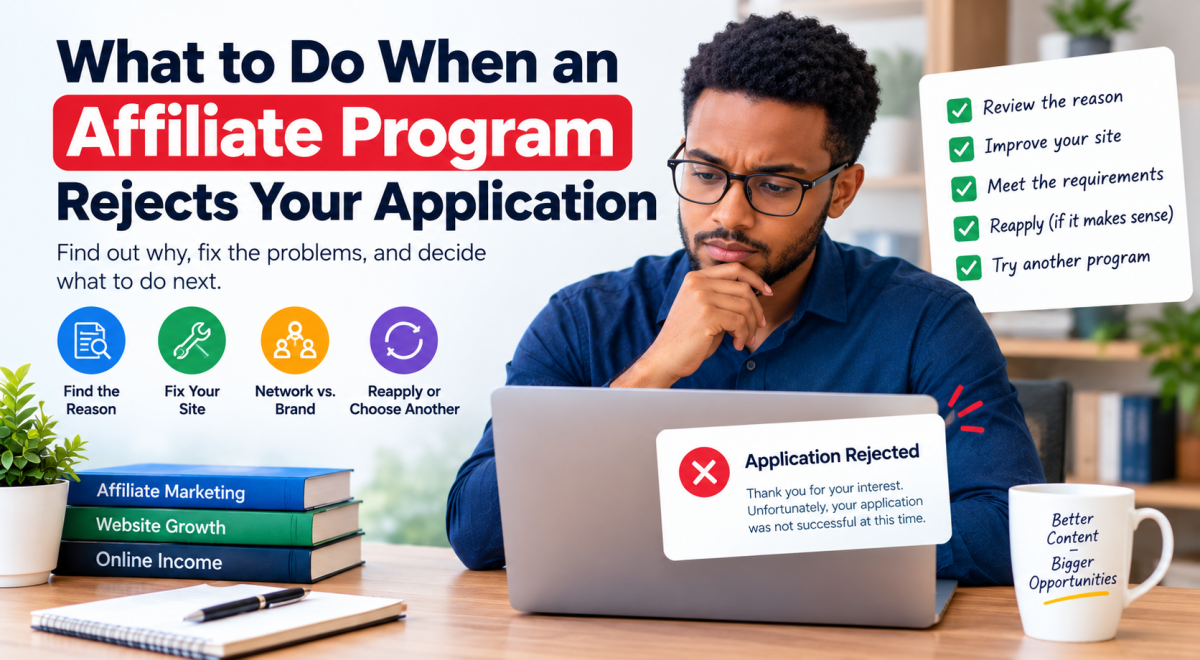
What to do when an affiliate program rejects your application
You spent weeks on the site, published the articles, read up on how affiliate marketing works, and then got a two-line email saying your application wasn’t successful. That stings.
One rejection doesn’t mean your site is a bad fit for affiliate marketing. The program may have wanted a different audience, an older site, or a different promotional method. But the right fix depends on the reason, and reapplying without changing anything usually gets you the same email again.
Here’s how to work out what went wrong, fix it, and decide what to do next.
1. Find out why you were rejected

Reread the rejection email before you change anything. Some programs name the problem. Others send a form letter. Look for any mention of content quality, traffic, missing information, promotional methods, location, or compliance.
These are the usual causes.
Not enough original content.
A new site with five short posts and a few product blurbs gives a reviewer little to judge. Programs want partners who help readers decide what to buy. A budgeting blog, for instance, would get further with one solid guide comparing three budgeting apps (cost, limits, who each suits) than with ten 300-word posts that repeat the sales pages.
Amazon Associates gives a concrete benchmark: its application guidance recommends at least 10 posts of robust original content. That’s Amazon’s rule, not an industry standard.
An unfinished site.
Broken links, empty categories, and no obvious owner or contact details make a site hard to evaluate. Open your own homepage as a stranger would. Can you tell within a few seconds what it covers, who it’s for, and how to reach the person behind it?
An audience that doesn’t fit.
A company that sells only in the UK may not want a publisher whose readers are mostly in Brazil. A B2B software company may pass on a general entertainment blog. That says nothing about the quality of your audience, only that it doesn’t match that program.
Wrong or missing details.
A mistyped URL, an unlisted promotional channel, or a traffic source you don’t actually use can all sink an application. Some programs also require proof that you own the site or control the social account you submitted. Check the current requirements instead of assuming every network works the same way.
Breaking program rules.
Programs often restrict paid ads, coupon sites, trademark use, email campaigns, or certain social placements. More traffic won’t fix a rules problem. Read the terms first.
2. Work out whether the network or the brand said no
This distinction can save you a lot of rebuilding.
A network, like Awin, connects publishers with many advertisers and handles tracking and payments. An individual program is run by one brand, which picks its own partners. Those are separate decisions, so you can be accepted by a network and still turned down by a brand on it.
Say you’re approved by a network and then apply to three software companies on it. One accepts and two decline. Your site probably doesn’t need a rebuild. Those two brands likely have different audience requirements or restrictions.
Here’s how to sort it out:
- Network rejection: check your account verification, application details, promotional channels, and the network’s publisher requirements.
- Brand rejection: look at the brand’s target audience, product relevance, traffic expectations, and program terms.
- Compliance rejection: find the specific policy you broke and fix it before doing anything else.
If the email doesn’t say which one it was, ask support whether the problem is with your publisher account or with the advertiser application.
3. Fix the site before you reapply
If the site is the problem, aim for useful and easy to evaluate. You don’t need a redesign, and you shouldn’t dump 30 rushed articles online.
Start with the content you already have. Does each post answer a real question or explain a decision? Does it include examples a reader couldn’t get from a product page? Then write about the products you actually want to promote. A site about starting an online business could publish:
- a comparison of Shopify and WooCommerce for first-time sellers
- a walkthrough for choosing an email marketing tool
- a breakdown of what running a small online store really costs
- a tutorial for one specific task, like setting up shipping rates
- a free-versus-paid tool comparison that’s honest about the limits of the free tiers
Each of those helps a reader even if they never click an affiliate link. Don’t churn out near-duplicate posts just to make the site look bigger. Google’s people-first content guidance rewards originality and usefulness, not word counts.
Make the site look finished.
Check for these:
- an About page that says what the site is for and who it serves
- a Contact page with a way to reach you that works
- a privacy policy covering the data you collect
- an affiliate disclosure explaining that some links may earn you a commission
- navigation that makes your main categories and best articles easy to find
- menus, text, and links that work on a phone
- no broken links, missing pages, or display glitches
Legal and policy requirements vary by country, audience, and agreement, so treat this as a readiness checklist, not a guarantee.
Show the site is active.
If your latest post is from eight months ago, update it or publish something new. Some programs care a lot about this. Amazon Associates, for example, says site content should generally be recent, meaning within the last 60 days. Other programs set their own standards, so check yours.
4. Look at your traffic and channels
After a rejection, most people ask whether they simply need more visitors. Sometimes yes. Some programs want an established audience, and others care more about relevance, compliance, or which channel you use. Unless the program told you traffic was the problem, don’t assume it was.
Check three things instead.
First, where do your visitors come from? Search, Pinterest, YouTube, a newsletter, and social media can all work for affiliate marketing, depending on the program’s rules.
Second, did you list the exact site or profile the application asked for? If a program doesn’t accept your channel, adding followers won’t change the outcome.
Third, does your audience fit the product? Two hundred readers searching for a niche tool can be worth more to that brand than 20,000 readers with no interest in it. That doesn’t guarantee approval, but it’s a better way to choose which programs to apply to.
If your traffic is low, keep publishing useful content and look at other programs in the meantime. Never buy followers, fake engagement, or inflate your numbers on an application.
5. Reapply, appeal, or move on
Reapply if the program allows it and you’ve fixed something concrete, like thin content, stale pages, or missing details on the application.
Contact the program if the reason is vague. Only use a formal appeal if the program offers one and your situation qualifies.
Move on if the brand doesn’t match your audience, its restrictions clash with how you promote, or its rules don’t allow another application.
Rules for rejected applications differ a lot. Amazon Associates says it can’t reassess an application once it’s been rejected, though its guidance does discuss applying again after you’ve built up the site and met the requirements. It also treats unsuitable-content rejections differently from other kinds. Read the current rules for your exact situation instead of assuming an appeal or second application will be accepted.
How long should you wait?
There’s no universal answer. If the program names a waiting period, follow it. If it lets you reapply once you’ve fixed the problem, the changes matter more than the calendar. If you were rejected for thin content, waiting two weeks and changing nothing won’t help. Publishing several well-developed guides, finishing your core pages, and fixing technical errors gives you a real reason to apply again.
Keep a short log of what you changed, when, and which requirement it addressed. It makes your next application much stronger.
6. Ask for feedback with a short, polite email
If the program lists a contact address or support form, you can ask whether they’ll explain the decision. Keep it brief. Don’t argue, don’t demand approval, and don’t claim your site meets requirements you haven’t actually checked.
Here’s a template to adapt:
Hello Affiliate Team,
Thank you for reviewing my application.
I saw that it wasn’t approved, and I’d appreciate any feedback you can share. If there are specific website, content, audience, or compliance requirements I should work on, I’d like to know what they are.
My website: [Your Website URL]
My main promotional channels: [Website, social media, YouTube, or other channels]
If reapplying or requesting reconsideration is allowed after I make improvements, could you tell me which steps you’d recommend?
Thank you for your time.
Best regards,
[Your Name]
Don’t count on a reply. Many programs don’t give individual feedback, and some have strict rules against reassessing rejected applications. If nothing comes back, don’t send the same request again. Go back to the program’s documentation and decide your next move from there.
7. Find programs that fit your site
A rejection from one company doesn’t end your affiliate plans. It’s a reason to look at businesses whose products and requirements match your audience better. Start with what your readers already need:
| Site niche | Possible affiliate offers |
| Personal finance | Budgeting tools, financial education products, eligible financial services |
| Blogging and online business | Hosting, website tools, email marketing software |
| Ecommerce | Store platforms, payment tools, inventory software |
| Productivity | Project management apps, calendars, workflow tools |
| Education | Learning platforms, books, study tools |
Those are product categories to research, not promises that any particular company will accept you.
Before you apply, compare each program’s eligibility rules, where it operates, commission structure, payment terms, cookie attribution rules, and promotional restrictions.
Don’t confuse a high commission with a good fit. A 40% payout on software your readers don’t need, can’t afford, or that you couldn’t recommend honestly won’t earn you much. A relevant product that solves a real problem for your audience will usually do better than an unrelated one with a bigger advertised rate.
Build a shortlist of three to five.
Don’t apply to everything you find. For each candidate, ask:
- Does this company sell something my audience needs?
- Does it accept publishers with my kind of site or channel?
- Can I meet its eligibility and compliance requirements?
- Are the payment terms and commission rules reasonable?
- Can I write something genuinely useful about its products?
Apply to the ones that pass. You’ll waste less time on applications that were never going to work and have more of it for the site.
8. Mistakes to avoid after a rejection
Some reactions to rejection make things worse.
Resubmitting with no changes. If the weakness is still there, you’ll likely get the same answer. Figure out the real issue first.
Inflating your numbers. Be accurate about your traffic and audience, and don’t claim channels you don’t control.
Adding affiliate links before reading the terms. Some programs have specific rules on link placement, disclosure, and use of their brand materials.
Padding the site with generic posts. Ten thin articles aren’t worth more than three good ones. Aim for original explanations and relevant examples.
Treating approval as the only progress. While you wait, or after a rejection, you can keep building your audience, improving your content, and researching products.
Taking it as a verdict on you. A company may just want a different kind of publisher. Learn from the decision, but don’t read it as proof the whole idea won’t work.
9. Your Affiliate Application Readiness checklist
Run through this before your next application:
- I understand the stated reason for the rejection, or I’ve read the program’s eligibility rules.
- My site or channel is publicly accessible where required.
- My content is original, useful, and relevant to my audience.
- My About and Contact pages are complete.
- My site works on mobile and has no obvious broken pages.
- I’ve checked the disclosure, privacy, trademark, and promotional requirements.
- My application has accurate URLs and audience information.
- The program lets me apply again, or I’ve confirmed the correct next step.
This is a preparation tool, not an official standard. A program may ask for things not covered here.
Frequently asked questions
Why do affiliate programs reject beginners?
Usually because the site has thin content, an undeveloped audience, or unfinished pages, or because the channel doesn’t meet the program’s requirements. Some programs also prefer publishers with an established audience. Each one decides on its own terms.
Can I join another program after being rejected?
Yes, if you meet that program’s requirements. One rejection doesn’t block you from unrelated programs. The exception is a network-level rejection or a compliance problem, which can affect more than one application, so check the relevant terms.
How many posts should I publish before applying?
There’s no universal number. It depends on the program and on how well your content shows what the site is for. Amazon Associates recommends at least 10 posts of robust original content, but other programs use different criteria.
Should I wait for more traffic?
Only if traffic is actually a requirement for that program. If you were rejected for incomplete information, unsuitable content, or a policy violation, fix that directly. Waiting for visitors won’t help.
Can I appeal a rejection?
Sometimes. Check the program’s official instructions and contact the relevant team if clarification is offered. Some programs allow appeals in certain cases, and others don’t reassess rejected applications at all. Don’t assume one company’s process applies to another.
What if my site is new and has almost no visitors?
Focus on publishing useful content, finishing the site, and building a relevant audience. Look for programs that accept publishers at your stage. Be honest about your traffic and plans, and apply once you can show a reasonable fit.
Final words
After a rejection, don’t rush to apply everywhere else. Find out what you can about the decision first, and work out whether the problem was your site, your audience, your application details, or that program’s own criteria.
Then fix what’s actually broken. If the program allows reapplication, apply again once your case is stronger. If it doesn’t, put your time into other programs instead of a closed door.
Affiliate marketing takes patience, but patience alone isn’t a plan. Each application, accepted or not, should teach you something about where your site fits, which products serve your readers, and how to build a business around content that’s actually useful.