
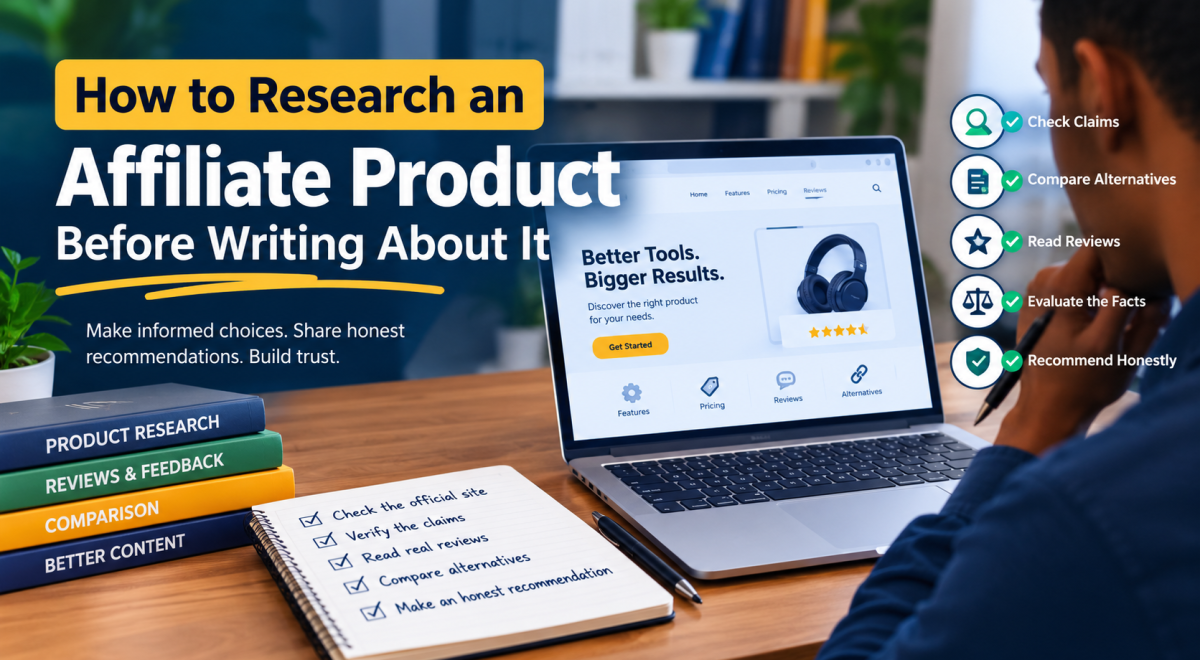
How to Research an Affiliate Product Before Writing About It
Picking an affiliate product is easy. Figuring out whether it deserves a recommendation takes work.
A product can have a slick sales page, glowing testimonials, and a generous commission, and still lack a feature your readers need, cost more than its competitors, or be wrong for your audience. If you write about it without checking, you risk publishing something misleading and losing your readers’ trust.
Start with the reader, not the commission. Find out what the product does, who it helps, where it falls short, and whether the evidence backs up the claims you want to make. Here’s how to do that step by step, even if you can’t afford to buy it.
1. Start with what your reader needs
Before you open the product’s website, decide what problem your article solves.
Two people searching “best budgeting app” want different things. One wants to stop overspending on takeout. The other is splitting rent and bills with three roommates. Same keyword, different apps. Email marketing works the same way: a new blogger with 50 subscribers doesn’t need automation features built for a company with 50,000.
Answer three questions:
- What problem is the reader trying to solve?
- Which features would actually change their result?
- What costs, limits, or hassles could stop them from getting that result?
Your answers also tell you what kind of article to write: a beginner’s guide, a single review, or a comparison.
Tip: Write one sentence describing your reader and their problem. Keep it open while you research.
2. Check the official website
The provider’s site is the place to confirm the basics: features, supported platforms, pricing, technical requirements, what’s included, and any stated limits. With software, see whether the features you care about are on the free plan or locked behind a subscription. With physical products, look at dimensions, materials, compatibility, included accessories, warranty, and care instructions.
Keep in mind that a sales page is a list of claims, not proof. If a company calls its software “the easiest option for beginners,” that’s marketing. You can say the company pitches it to beginners. You can’t state it as fact unless you have evidence.
Save links and notes as you go. You’ll need them to fact-check before you publish, and again when the product changes.
3. Verify the important claims elsewhere
Some details check out in the official documentation. Others take more digging.
Say a project management tool claims it integrates with a certain email service. Check the tool’s integration directory, and if you can, the email provider’s own docs. If a company says its product cuts costs or improves performance, look for how the result was measured, who was studied, and under what conditions.
The Federal Trade Commission says objective advertising claims need a reasonable basis before they’re published, and how much evidence that takes depends on the claim and what’s at stake. Its advertising substantiation guidance is worth a read.
A simple way to keep track:
| Product claim | Evidence to look for |
| Includes a particular feature | Official documentation or a product demo |
| Works with another platform | Official integration documentation |
| Costs a stated amount | Current pricing page and terms |
| Improves a measurable result | Reliable evidence for that specific outcome |
| Is good for beginners | Usability evidence, documentation, and user feedback |
If you can’t verify a claim, cut it, qualify it, or say it comes from the seller. Be strictest with financial products, health products, and security software, where one wrong detail can hurt someone.
4. Read customer reviews closely

Reviews catch what product descriptions skip: a confusing setup, support that takes a week to reply, a feature that works differently than people expected. Treat them as leads to investigate, not as answers.
Look past the star rating. Read the positive, the negative, and the middling ones. Pay attention to reviewers who describe what actually happened, what their situation was, and whether the same complaint shows up in independent sources.
Ask yourself:
- Does the reviewer describe a specific experience?
- Is the review recent enough to reflect the current product?
- Is the complaint about the product, or about an unusual use case?
- Are several people reporting the same problem?
- Could the reviewer be getting paid or otherwise rewarded to promote it?
Be wary of gushing reviews with no details, repeated phrasing across different reviews, and claims that sound too good to be true.
One bad review doesn’t make a bad product, and a pile of good ones doesn’t prove every feature works as advertised. Look for patterns, then verify what matters.
5. Compare with real alternatives
A product can be good without being right for everyone. Pick two or three reasonable alternatives and compare them on what matters to your audience: price, features, ease of use, support, compatibility, cancellation terms, and limits.
If you’re comparing email platforms for a new blogger, you’d check:
- Whether there’s a free plan, and what it includes
- Whether automation is included or limited to paid plans
- How subscriber limits and extra charges work
- Whether it connects to the blogger’s website
- How easy it is to export contacts and leave
Check the same things for every product. Putting one product’s entry-level plan next to another’s premium plan gives you a misleading comparison.
A table helps while you research:
| Factor | Product A | Product B | Product C |
| Starting cost | Verify current price | Verify current price | Verify current price |
| Main features | Record verified features | Record verified features | Record verified features |
| Best-fit user | Based on your research | Based on your research | Based on your research |
| Main limitation | Document the drawback | Document the drawback | Document the drawback |
Those cells are placeholders, not findings. Fill them with verified information before you publish.
Your comparison should show readers which option fits their situation, not just crown a winner without saying why.
6. Check pricing, refunds, and hidden costs
Price gets its own step because it can make or break a reader’s decision.
A low introductory rate can jump after the trial ends. A “$9 a month” plan might only be sold as an annual payment. Some products charge extra for more users, more storage, more transactions, or the features you actually wanted.
Before you write about cost, check:
- The current price and how often it’s billed
- Whether that price is an introductory rate or what you’ll pay long term
- Whether taxes or extra fees apply
- What happens when the free trial ends
- The refund conditions and deadlines
- Whether canceling takes extra steps
- Whether key features sit behind higher-priced plans
For physical products, add shipping charges, return conditions, warranty coverage, and whether replacement parts are available.
Don’t assume a money-back guarantee exists just because an affiliate site mentions one. Confirm it on the provider’s current policy page.
And don’t present a price as permanent. If prices change often, say when you checked and link to the official pricing page so readers can confirm the latest number.
7. Decide whether you can test it
Hands-on use tells you things desk research can’t.
If you have access to the product, use it for the tasks your review covers. For a budgeting app, that might mean building a sample budget, categorizing a week of expenses, and seeing how it handles a recurring bill. For a website builder, build a basic page and check how it looks on a phone.
Write down what you did, what worked, what gave you trouble, and what you didn’t get to test. Add screenshots, photos, or measurements where they back up your findings.
Google’s guidance on writing high-quality reviews asks for original analysis, evidence of first-hand experience, meaningful comparisons, and a clear account of a product’s pros and cons.
What if you can’t afford the product?
You can still publish something useful. Just be upfront about how you researched it.
Draw on official documentation, product demos, independent reviews, technical specs, and reliable third-party sources. Say which findings come from documentation and which come from other people’s reported experiences.
Never write “I tested this tool” or “I’ve used this for a month” if you haven’t. And don’t pass off desk research as a hands-on review. A research-based comparison that’s labeled as one can still be valuable, as long as you explain its limits.
8. Look into support and reliability
A product’s value depends partly on what happens when something breaks.
For software, look at the support channels, the quality of the documentation, how often it’s updated, and any known compatibility problems. For physical products, check the warranty, repair options, replacement-part availability, and how defects get handled.
Look for recurring problems, not one-off complaints. Several recent reports of the same unresolved bug are worth chasing. But first find out whether they apply to the current version and whether the company has acknowledged or fixed the issue.
If you can’t get a full picture, say so instead of forcing a conclusion.
This matters most when the product handles sensitive information, runs part of someone’s business, or bills on a subscription.
9. Check the affiliate program on its own

A good product and a good affiliate program are separate things.
Once you’ve evaluated the product, read the program’s terms: commission rates, attribution windows, payout thresholds, which transactions qualify, limits on how you can promote, and rules for using trademarks or product images. Also check that the program allows the kind of content and traffic you plan to use.
Some programs restrict certain paid ad methods or set specific requirements for tracking links, for instance. Read the current agreement. Don’t rely on an old tutorial or a screenshot of a commission rate.
Amazon Associates is one example of a program with formal participation requirements. Its Associates Program Operating Agreement is where you’d check its current rules.
Don’t let a high commission pick your recommendation for you. A cheaper product that fits your reader may be the better call than a higher-paying one with real drawbacks.
10. Build the article around evidence
When the research is done, organize everything around the decision your reader has to make. A solid review or comparison usually covers:
- What the product does and who it’s for
- Which features matter most and how they work
- What it costs and what that price includes
- Its biggest strengths and most meaningful limits
- How it stacks up against relevant alternatives
- Who should consider it and who might prefer something else
- Where readers can find current product information
Keep confirmed facts separate from your own interpretation. If you tested the product, describe the tests. If you didn’t, explain your sources and method.
Don’t copy a manufacturer’s feature list and call it an independent review. Your article is worth reading because you interpret the evidence, explain the trade-offs, and help people decide.
Include a clear affiliate disclosure
If you earn a commission when readers buy through your links, say so clearly, and put the disclosure near the recommendations it applies to. For example:
“I may earn a commission if you purchase through links in this article, at no additional cost to you.”
The FTC’s guidance on affiliate disclosures and endorsements explains why these relationships have to be disclosed clearly and conspicuously.
Check the rules for your audience and location, plus your affiliate program’s own requirements. And remember that a disclosure doesn’t excuse an unsupported claim.
11. Run a final checklist
Before you publish, go through this list:
- The product meets a real need for my target audience.
- I checked the official website and documentation.
- Important claims are backed by appropriate evidence.
- I read customer feedback and didn’t lean on star ratings alone.
- I compared the product with relevant alternatives.
- I checked current pricing, billing terms, and refund conditions.
- I made clear what was first-hand testing and what was desk research.
- I named real disadvantages and limitations.
- I checked the affiliate program’s current rules.
- My recommendations match the evidence and the audience.
- My affiliate disclosure is clear and easy to find.
- I included useful source links and removed unsupported claims.
If big questions are still unanswered, hold off on the recommendation or explain the uncertainty. You don’t have to reach a positive conclusion the evidence doesn’t support.
Common affiliate research mistakes
Choosing products because they pay well. A high commission says nothing about quality or fit. Evaluate the product first and the deal second.
Trusting the sales page. Official pages are fine for specs and terms. Marketing language isn’t independent evidence.
Relying on one review. One person’s experience may not match everyone else’s. Look for patterns, and verify serious complaints.
Skipping the downsides. Leave out relevant drawbacks and readers show up unprepared for the product’s limits.
Using outdated information. Pricing, features, ownership, and program terms all change. Recheck anything time-sensitive right before you publish.
Pretending you tested it. A research-based article can still help people. Lying about your experience sinks the credibility of the whole review.
Frequently asked questions
How long should affiliate product research take?
It depends. A simple product with clear documentation may take an hour or two. A complex service or an expensive purchase can take far longer. Spend enough time to verify the claims that could affect a reader’s decision.
Can I write an affiliate review without buying the product?
Yes, as a research-based review or comparison. Just don’t imply you tested it yourself. Explain your method, use reliable sources, and say what you couldn’t verify.
What are the best sources for product research?
Start with the official website, documentation, pricing pages, policies, and support resources. Then add independent reviews, credible specialist publications, customer feedback, and technical evidence. The right source depends on the claim you’re checking.
How many products should I compare?
Two or three relevant alternatives is usually enough for a focused article. Add more only if they help readers see real differences, not just to pad the length.
Should I promote a product with a high commission but mixed reviews?
Not automatically. Find out why the feedback is negative and whether the problems are recurring or already fixed, then compare it with alternatives. If serious concerns remain, pick a better-supported option or spell out the risks.
How often should I update an affiliate article?
Update it when something significant changes: new pricing, discontinued features, a revised refund policy, or changes to the affiliate program. For fast-moving products, schedule regular checks. Only update when you’ve verified something new, not just to bump the publication date.
Conclusion
Researching an affiliate product properly means looking past the commission and the marketing. You need to understand what your audience needs, verify the product’s claims, compare realistic alternatives, check the pricing, and find the limits that could change someone’s mind about buying.
You don’t always have to buy a product to write useful content about it. You do have to be honest about what you know and how you found it out.
When your recommendations rest on evidence, and you explain who a product suits, where it falls short, and what else is out there, readers can choose with confidence. That’s the point of affiliate content: helping people choose well, not just getting them to click.