
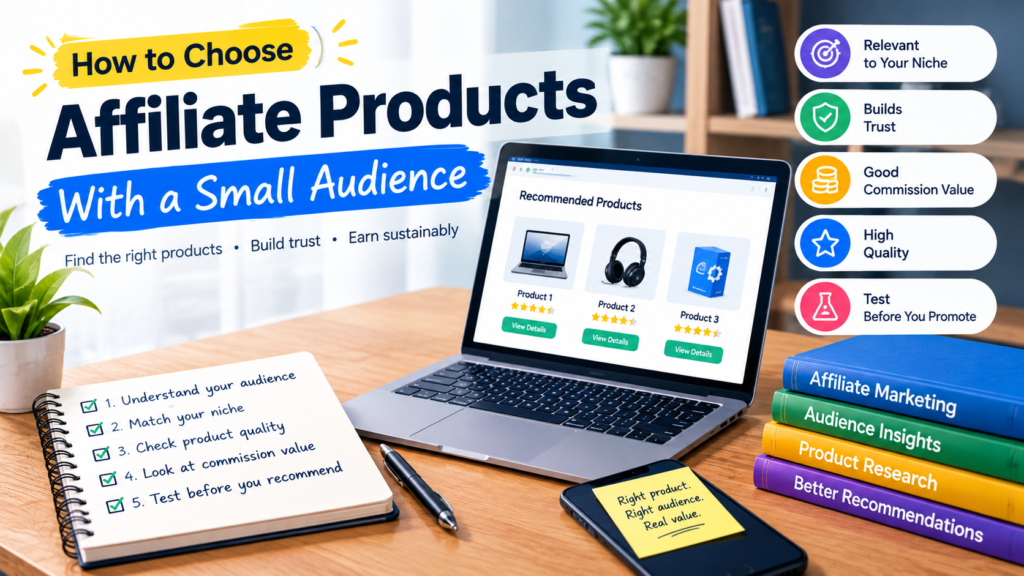
How to Choose Affiliate Products With a Small Audience
You don’t need thousands of followers to start with affiliate marketing. You need to know what your readers are trying to do and recommend things that help them do it.
With a few hundred visitors or subscribers, every recommendation counts. Promote something irrelevant and you waste your time and spend trust you haven’t built up yet. Small audiences do have one advantage: if they’re specific, you can be useful to them in a way a bigger, more scattered creator can’t. A blogger whose readers all want cheap budgeting tools will usually do better recommending one than a creator with a huge, mixed audience.
So skip the hunt for the program with the highest commission. Find products your readers need that fit what you already write about.
1. Start with your readers’ problems
Beginners often sign up for a pile of affiliate programs before asking what their audience needs. A company can offer a great commission on a product your readers have no use for. If people come to your site to learn how to save money, a pricey business coaching program is a hard sell.
Start with the problems instead. What questions do readers keep asking? What are they trying to finish? What do they keep getting wrong? What limits them: a tight budget, no experience?
Your best-performing articles, comments, email replies, social threads, and niche forums all hold clues. Treat them as clues only, though. A handful of comments doesn’t prove your whole audience wants the same thing.
Say you write about personal budgeting. Your readers might want a spreadsheet, a budgeting app, a debt payoff calculator, or a beginner finance book. Those solve different problems. Someone who doesn’t want a monthly subscription will probably prefer the spreadsheet. Someone tired of typing in every coffee purchase will want an app with automatic tracking. Your job is to match the solution to the person.
2. Pick products that fit your niche


A focused niche makes this easier, because each recommendation ties back to a specific need. If you cover budgeting, saving money, affiliate marketing, small business, and content creation, organize your options around those topics. Don’t promote something just because a program accepted you.
| Content niche | Possible affiliate products | Reader’s main need |
| Personal budgeting | Budgeting apps, spreadsheets, finance books | Track spending and manage money |
| Saving money | Price comparison tools, cost-cutting services | Cut everyday expenses |
| Affiliate marketing | Link management tools, email marketing software | Manage and improve campaigns |
| Small business | Invoicing tools, web hosting, business software | Run the business more efficiently |
| Content creation | Design tools, editing software, writing tools | Make better content faster |
These are categories, not endorsements. Every product still needs checking for quality, price, fit, and program terms.
Here’s a quick test: can you explain the product’s value inside an article you’ve already written? A post on building a household budget could include a free spreadsheet template, then compare a few paid apps for readers who want more. The recommendation grows out of what the reader is already doing. If you can’t say why a product belongs in an article, it probably doesn’t.
3. Check quality before commission
A big commission looks tempting when traffic is thin, but it says almost nothing about whether a product deserves a recommendation. It might be expensive, confusing, badly supported, or wrong for your readers. A cheaper product with a smaller payout that fixes a common problem is often the better pick.
Before you commit, ask these questions:
Does it solve a real problem?
You should be able to name the specific result a customer can reasonably expect. If the benefits are vague or rely on big promises, skip it.
Is it reliable?
Look at the features, documentation, support, refund policy, and recent user feedback. Pay attention to complaints that keep coming up. One angry review or one glowing one tells you little.
Is the price reasonable for your audience?
Compare it with the alternatives. A beginner on a small budget may be better served by a $5-a-month tool than a premium plan.
Can you verify the claims?
Use official docs, demos, free trials, or your own testing. If you haven’t used the product, don’t write as if you have.
Is the company upfront?
Read the terms, billing practices, and cancellation process.
You don’t have to become an expert in every category. You do need enough reliable information to say what the product does, who it suits, and where it falls short.
Google’s guidance on creating helpful, reliable, people-first content asks publishers to offer original value and show real experience and expertise. For affiliate content, that rules out rewording the manufacturer’s sales page.
4. Work out what each offer is worth
Once a product passes on quality and relevance, look at the money. Gather four details: the price, the commission rate or flat fee, whether the commission is one-time or recurring, and the conditions a sale must meet to count.
For percentage commissions, the math is simple:
Commission per sale = product price × commission rate
Take two hypothetical products:
| Detail | Product A | Product B |
| Price | $20 | $100 |
| Commission rate | 10% | 20% |
| Commission per qualifying sale | $2 | $20 |
Product B pays ten times more per sale, but that doesn’t make it the better choice. If A is a budgeting tool your readers want and B is an expensive service they’ll never buy, A is the smarter recommendation. Also factor in how likely a sale is, refunds, attribution rules, and how much work it takes to write something useful about each one.
To compare offers, estimate earnings from a set number of relevant visitors:
Estimated earnings = visitors × conversion rate × commission per sale
Say 200 relevant visitors land on a product comparison page and 5% buy. That’s 10 sales. At $4 per sale, you’d earn $40. That 5% is made up for the example, not a typical or promised rate, and your real numbers could be far lower or higher. The calculation shows how traffic, buyer interest, and commission fit together. It isn’t a forecast until you have your own data.
Also keep a merchant’s advertised conversion rate separate from yours. Theirs may come from a different audience, traffic source, or way of measuring.
5. Look for buying intent
Visitors aren’t all equally close to buying. Someone searching “what is budgeting” probably wants basic information. Someone searching “best budgeting app for couples with separate bank accounts” has a specific problem and is likely comparing options. Neither reader is worth more than the other, but the second search gives you a clearer chance to help with a decision.
When you pick products, think about which questions your content can answer. Comparisons that explain real differences work well. So do reviews that name strengths, limits, and who a product suits, tutorials for a specific task, cheaper alternatives to a popular product, and buying guides that separate the features that matter from the ones that don’t.
For example, instead of a generic article about budgeting software, compare free spreadsheets with paid apps for people with irregular income. That gives readers a way to decide, and it makes it easy to say why one option fits one person and not another.
Don’t turn every article into a sales page. If the best answer to a reader’s question is free, say so.
6. Score your shortlist
When you have several candidates, rate them all on the same criteria instead of going with a gut feeling. This scoring system is a practical tool, not a validated formula.
Rate each product from 1 to 5 in five categories, then multiply by the weights below.
| Criterion | Weight |
| Audience relevance | 30% |
| Product quality and reliability | 25% |
| Price suitability | 15% |
| Evidence supporting its benefits | 15% |
| Commission and program terms | 15% |
The weights add up to 100%, so the final score stays between 1 and 5.
Here’s a hypothetical budgeting app. It scores 5 for relevance, 4 for quality, 5 for affordability, 4 for evidence, and 3 for commission terms:
(5 × 0.30) + (4 × 0.25) + (5 × 0.15) + (4 × 0.15) + (3 × 0.15) = 4.30
A 4.30 means the product deserves a closer look. It doesn’t mean anyone will buy it.
Only compare products in the same category. And treat some problems as automatic rejections: serious quality concerns, misleading claims, or bad terms. A high score or a big commission shouldn’t rescue those.
7. Read the affiliate program’s terms before you join


A good product is only half the decision. The program that pays you has its own rules, and they can make or break the deal.
Before you apply, read the official terms and look for these things:
- Commission structure: a percentage, a flat amount, or recurring payments?
- Attribution window: how long after someone clicks can a purchase still earn you credit?
- Payment requirements: is there a minimum payout, and which payment methods and countries does it support?
- Approval rules: does the company accept new sites, small creators, and the kind of traffic you get?
- Promotion restrictions: are there limits on paid ads, email, social media, coupon sites, or brand keywords?
- Refunds and cancellations: can a return or a canceled subscription reverse your commission?
These details decide whether a program works for you in practice. If most of your traffic comes from Pinterest, confirm the program allows promotion there. If your readers live in several countries, check that they can buy the product and that the program pays out for those markets.
Programs don’t share one set of rules. Amazon Associates, for example, has its own qualifying-purchase requirements and promotional policies, and they differ by marketplace. Read the current agreement for the one you’ll use. Amazon’s program policies page is a good place to start.
And don’t trust a commission rate you saw in an old blog post. Rates, eligibility, and conditions change.
8. Start with a few products
With a small audience, spreading yourself across dozens of products means you never learn what works. Start with one to three products that solve related problems.
A beginner business blog might pick an affordable email marketing tool, a web host, and a free or cheap design tool. They do different jobs, but all three fit a blog about starting an online business. You could write a tutorial on setting up an email list, a comparison of hosting options, and a guide to making simple marketing graphics.
That focus lets you learn each product properly, write better content, and see which recommendations get clicks and sales. Just don’t add a product to fill a slot. One excellent recommendation beats three weak ones.
A free tool can also be the right starting point. Explain what it can’t do, and bring in a paid alternative only when the extra features solve a problem your readers actually have.
9. Test your choices with useful content
Picking a product doesn’t end when you publish the first affiliate link. Watch how readers respond and adjust.
Start with a specific question your audience likely has, then answer it thoroughly. If you’re considering a budgeting app, you might write a guide to setting up a monthly budget, then follow it with a comparison of the app against a spreadsheet. Cover the features, pricing, limitations, and who it suits. Make it clear which details come from your own testing and which come from the company’s documentation.
Then look at the data:
| Metric | What it can tell you |
| Relevant page visits | Whether the topic attracts readers |
| Affiliate link clicks | Whether readers are interested in the recommendation |
| Click-to-sale conversion rate | How often tracked clicks lead to qualifying sales |
| Earnings per click | The average commission per tracked click |
| Refunds or reversals | Whether your reported commissions hold up |
Read these together. No single number tells the story.
If an article gets visits but few clicks, the recommendation may be buried, thinly explained, or off-target for the reader. If readers click but don’t buy, the cause could be the price, the checkout, the audience fit, or the merchant’s offer, and click data alone can’t tell you which. If a product makes sales but keeps drawing complaints from your readers, think hard about whether it deserves your recommendation.
Give each test enough time and enough relevant traffic. A handful of clicks can’t establish a conversion rate, and there’s no magic visitor count that guarantees a clear result.
10. Be honest in your recommendations
Your readers’ trust takes a long time to build and not long to lose. If you wouldn’t recommend a product without the commission, don’t recommend it with one.
You don’t have to buy everything before you mention it, but be upfront about what your recommendation rests on. If you tested it, say what you tested and what happened. If you went by the official documentation and independent customer feedback, say that where it matters.
Skip claims like “the best tool for everyone” unless you can back them up. Say who benefits, who probably doesn’t need it, and what the alternatives are.
You also need to disclose affiliate relationships clearly. The US Federal Trade Commission’s guidance on affiliate marketing disclosures says readers should be able to tell when an endorsement involves a financial relationship. A simple disclosure might read:
“Affiliate disclosure: This article contains affiliate links. If you buy through them, I may earn a commission at no extra cost to you. I only recommend products I think could be useful to my readers.”
Word yours to describe your actual relationship with the companies you promote. Put it where readers will see it before or at the point they meet an affiliate link, and follow the laws and platform rules that apply to your audience and location.
Honesty doesn’t mean every recommendation has to be negative or hedged. It means giving readers enough to make their own call, limitations included.
11. Common mistakes
- Choosing products only because they pay well. A big commission can’t make up for poor fit or a product you can’t stand behind.
- Promoting too many unrelated products. A scattered selection confuses readers and makes it harder to build expertise in your main topics.
- Copying other affiliates’ picks. A product that works for another site’s audience may not work for yours. Check it against your own readers’ needs.
- Ignoring the full cost to the customer. Look at subscriptions, renewals, add-ons, cancellation terms, and whether the product only works with other paid tools.
- Making claims you can’t support. Don’t promise savings, growth, or earnings just because the company’s marketing does.
- Giving up after a few clicks. Small samples are noisy. Review the content, the audience fit, and the data before you decide a product has failed.
- Treating every visitor as a buyer. Some people want information, some want to compare, and some are ready to purchase. Write for each of them.
The principle behind all of these is simple. Choose products based on the problems your readers need solved, not on the affiliate links you happen to have.
Frequently asked questions
Can you make money from affiliate marketing with a small audience?
Yes, if your readers’ needs match what you recommend and some of them buy. How much depends on audience fit, product quality, traffic, conversion rates, and commission terms. Nothing is guaranteed.
How many affiliate products should a beginner promote?
There’s no ideal number. One to three well-matched products make it easier to learn them, write useful content, and judge the results. Add more when they cover different reader needs.
Should I choose high-ticket products?
Not automatically. They pay more per sale, but buyers usually need more trust, more spending power, and more time to decide. Compare them with cheaper options and pick whatever suits your audience.
Is it better to promote digital or physical products?
Neither wins across the board. Digital products include software, courses, and subscriptions. Physical ones include equipment, books, and household goods. Compare usefulness, price, support, commission terms, refund policies, and fit for your readers.
How do I find affiliate products if I have no sales yet?
Start with the problems your existing content already addresses. Find relevant products, check their quality and affiliate terms, and see whether they accept publishers at your stage. You can also email companies directly and ask about their programs. You don’t need past sales to research, though some programs have minimum requirements to join.
Should I recommend a product I’ve never used?
You can, as long as it’s based on solid research and you don’t claim personal experience. Say what you verified and what you didn’t test. For a detailed review, hands-on testing gives you evidence you can’t get from a product page.
How long does it take to earn a first commission?
There’s no dependable timeline. It depends on your traffic, your readers’ needs, the products you pick, your content, and how long people take to buy. Focus on publishing useful content and collecting enough data to make informed choices, rather than setting a deadline.
Final words
Choosing affiliate products with a small audience comes down to understanding what your readers need. The size of the commission matters much less.
Start with the problems your content already helps with. Check each product for relevance, reliability, price, and real benefits, read the program’s terms, and begin with a short list you can explain with confidence. Then let your content and data tell you what to keep. If a product gets interest but doesn’t convert, find out why before replacing it. If one keeps failing your readers, drop it.
You don’t need a big catalogue of links. You need a clear reason for each recommendation, and enough useful information that readers can decide for themselves.