
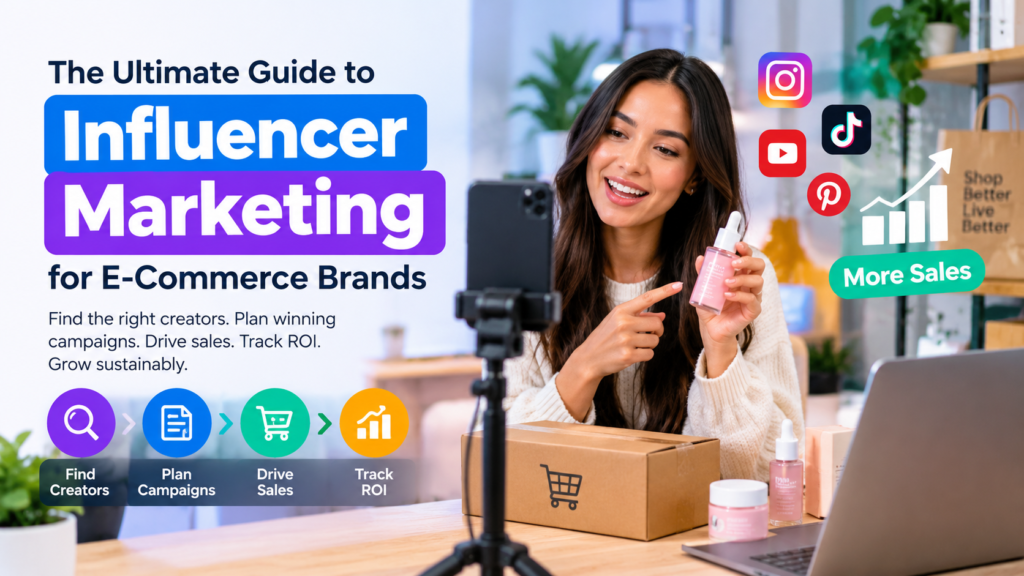
The ultimate guide to influencer marketing for e-commerce brands
Influencer marketing lets an online store put its products in front of people who already trust a particular creator. A creator can show how a product works, answer the questions a product page can’t, and send interested viewers straight to your shop. You skip some of the cold-audience problem that comes with paid ads.
It doesn’t guarantee sales, though. A creator with 200,000 views can send you almost no buyers, while a creator with 8,000 followers in the right niche can fill your inbox with orders. What separates the two is usually strategy: who you pick, how clearly you brief them, and what you measure afterward.
This guide walks through that process, from finding creators to judging results.
What is influencer marketing for e-commerce?

It’s a promotion strategy where a brand works with a content creator to introduce or recommend its products. The collaboration might be a sponsored video, a review, a tutorial, a livestream, a social post, or an affiliate arrangement.
The goal varies. Some brands want awareness, some want website visitors, some want first orders, and some want past customers to buy again.
Say a small skincare store partners with a creator who posts nightly routine videos. She shows the texture of a new moisturizer, explains where it fits between serum and sunscreen, and drops a tracked link in her caption. Viewers who were already interested in skincare can click through and buy.
That’s the pattern that works: the product, the creator’s audience, and the campaign goal all line up. Follower count alone tells you very little about whether a partnership will turn a profit.
Why it matters for online stores
Shoppers can’t pick up a product before buying it online. Creator content closes some of that gap by showing the item in use and answering practical questions.
Reaching people who already care
Creators build audiences around specific interests like fitness, home organization, or gaming gear. A store can borrow that trust and reach people who are far more likely to want the product than a general ad audience. So the question to ask isn’t “how many followers?” but “do these followers look like my customers?”
Showing the product in real situations
A photo shows what something looks like. A video shows whether it works. If you sell stackable storage containers, a creator can film them fitting into a cramped apartment kitchen, which tells a viewer more than a white-background product shot.
Keep demonstrations honest. Exaggerated claims hurt the creator’s credibility and yours.
Getting content you can reuse
With permission, a creator’s content can go on product pages, in emails, and into your own social ads. Before you do any of that, agree in writing on usage rights, which channels you can run it on, and how long the license lasts. Otherwise you can end up with great footage you’re not allowed to use.
Tracking sales
Unique links, discount codes, and affiliate tracking help you tie purchases to specific creators. They’re imperfect. Someone might see a creator’s video on Monday and buy from a Google search on Friday. A discount code might get posted on a coupon site and used by people who never saw the content. Read tracking numbers next to your overall sales trends, not on their own.
Types of influencers you can work with
The right partner depends on your product and your goal.
Nano-influencers
(roughly 1,000 to 10,000 followers) suit small tests, product seeding, and tight-knit communities. Their reach is small, and a small audience doesn’t automatically mean high engagement.
Micro-influencers
(roughly 10,000 to 100,000) are a common starting point for niche stores, since you get relevant audiences and easier communication. Still check their real audience data. Being “micro” doesn’t make someone a better performer.
Macro-influencers
(roughly 100,000 to 1 million) offer wider reach and often more polished production, at higher fees. Decide whether the extra exposure justifies the cost for your budget.
Mega-influencers and celebrities
(over 1 million) can deliver big exposure at big prices. Brand fit and measurable results still matter, probably more than at any other tier.
These ranges are industry habit, not a standard, and different agencies draw the lines in different places. Follower count never tells you a creator’s value by itself.
There’s a related option worth knowing about: user-generated content (UGC). Here you pay a creator to make content for your own channels, and they may never post it to their own audience. It’s a different service from influencer marketing, and it works well for product pages and ads.
How to build an influencer marketing strategy

Step 1: Pick one goal
Decide what the campaign has to accomplish. Common goals are:
- Awareness of a new product
- Qualified traffic to product pages
- First-time purchases
- Testing a new customer segment
- Product demo content you can reuse
- Repeat purchases from existing customers
Choose one main goal and a few supporting metrics. A brand-awareness campaign shouldn’t be judged the way you’d judge a campaign built for immediate sales.
If you’re launching a reusable water bottle, for example, you might focus on qualified visits and first orders, then check customer acquisition cost and average order value to see whether the numbers hold up.
Step 2: Know who you’re selling to
Before you search for creators, write down who actually buys. Think about their interests, location, budget, the problem they’re trying to solve, which platforms they use, and why they’d buy.
A premium home decor store wants creators whose followers like interior design and don’t mind higher prices. A student accessories brand with low price points fits better with creators who talk about budgeting and campus life.
Pull this from real data where you have it: customer reviews, support emails, website analytics. The sharper your customer profile, the easier it is to tell whether a creator’s audience is a match.
Step 3: Find creators who fit
Search your platforms using niche keywords, product categories, hashtags, and the phrases your customers use. Look for people already making content about your product or the problem it solves. Creators who cover competing products can also be good candidates, as long as their audience suits you.
For each candidate, ask:
- Do they regularly post about things related to your product?
- Do the comments look genuine and on topic?
- Does their audience match your target market?
- Is their content clear, useful, and consistent?
- Did they handle past sponsored posts professionally?
- Are there signs of fake growth or copy-paste engagement?
- Do their usual recommendations sit comfortably next to your brand?
For any paid partnership, ask for recent audience demographics and performance data. Public likes and comments can’t tell you audience quality, reach, or how likely people are to buy.
Build a short list and write to each person individually. Mass-sending the same generic message to hundreds of accounts rarely works.
Step 4: Choose a collaboration model
Each model carries different costs and risks.
| Model | How it works | Best for |
| Product gifting | The creator receives a product, with no guaranteed post unless agreed | First outreach and product discovery |
| Flat-fee sponsorship | You pay an agreed amount for specific deliverables | Planned campaigns with defined content |
| Affiliate partnership | The creator earns commission on qualifying sales | Testing sales performance and ongoing promotion |
| Hybrid agreement | A fixed fee plus commission or a performance bonus | Guaranteed work with a sales incentive |
| UGC production | The creator makes content for you to publish | Product pages, ads, and your own social accounts |
No model wins every time. Gifting costs little upfront, but a creator who hasn’t agreed to post doesn’t have to. Affiliate deals keep your fixed costs down, though creators may pass if the commission is low or the product is hard to sell.
For a first campaign, a small flat-fee test or a clearly defined hybrid deal gives you predictable costs and results you can measure.
Step 5: Write a clear brief
A good brief tells the creator what to deliver and leaves room for their own style. Include:
- The product and who it’s for
- The campaign goal and key message
- Deliverables (for example, one video and two stories)
- Posting dates and approval deadlines
- Product claims you can back up
- Required sponsorship disclosures
- Tracking links, discount codes, or affiliate terms
- Content usage rights and any exclusivity restrictions
- Payment terms and cancellation conditions
Don’t script every line unless the format truly demands it. Creators know their audience, and heavy-handed instructions tend to produce stiff videos that people scroll past.
But do give them accurate product information and firm boundaries. Never ask a creator to say they’ve used a product when they haven’t, or to promise results you can’t support.
Step 6: Make buying easy
Strong content can still flop if your store is hard to use. Before the post goes live, check that the product is in stock, the landing page loads well on a phone, delivery information is easy to find, and checkout works.
Give each creator a unique tracked link. If you’re offering a discount code, state its conditions and expiry date plainly.
And send people to the right place. A creator promoting a backpack should link to that backpack’s product page, not your homepage, where viewers have to hunt for it. It cuts friction, and it makes the campaign easier to read afterward.
How much should an e-commerce brand spend on influencer marketing?
There’s no standard price. What a creator charges depends on their audience, the platform, the content format, how much production is involved, whether you get reuse rights, and how well you negotiate.
One creator might charge for a single short video. Another might offer a bundle of posts plus permission to reuse them in your ads. Treat any published rate list as an opening position for negotiation, not a market price.
If you’re just starting out, set a test budget you could lose entirely without hurting the rest of the business. That’s the whole rule.
Example: planning a small campaign
This is a made-up scenario, not a market rate or a real result. Say an online store has $600 to test with:
| Expense | Example allocation |
| Two creator partnerships | $300 |
| Product samples and shipping | $100 |
| Content usage and editing | $100 |
| Testing and contingency | $100 |
| Total | $600 |
Real fees and shipping costs could be far higher or lower than these. The budget exists to test a couple of relevant partnerships, find the operational snags, and collect some data before you spend more.
Don’t put the whole budget into creator fees. Product costs, shipping, discount margins, and returns all come out of the same pot.
How to measure results
Decide what success means before the content goes live. If you wait until the end, you’ll probably find the data you collected can’t answer the questions you actually have.
Pick your metrics
Different metrics answer different questions:
- Awareness: reach, impressions, video views, audience growth. These show exposure, but they don’t prove anyone bought anything.
- Traffic: link clicks, landing-page sessions, product-page engagement. These show whether people took the next step.
- Sales: orders, conversion rate, average order value, revenue from tracked purchases. These sit closer to business results.
- Profitability: customer acquisition cost and what’s left after relevant costs. These tell you whether the campaign was worth running.
For sales-focused campaigns, use unique links with UTM parameters, a discount code for each creator, and your store’s analytics. Shopify’s guide to measuring influencer performance covers tracking sales, conversions, traffic, and average order value if you want a walkthrough.
Calculate ROI carefully
The standard formula is:
ROI (%) = (incremental profit − campaign cost) ÷ campaign cost × 100
Incremental profit means the extra profit the campaign actually caused, which isn’t the same as total revenue on a tracking link. Some of those buyers would have found you anyway. Isolating the true figure is hard, so treat the result as an estimate unless you’re using a more rigorous method.
For a simpler day-to-day comparison, use the revenue-to-cost ratio:
Revenue-to-cost ratio = attributed revenue ÷ campaign cost
Here’s a hypothetical. A campaign costs $500 and brings in $1,500 in tracked sales. That’s a 3:1 ratio, but it doesn’t mean you made $1,000. Suppose product costs, shipping subsidies, discounts, and payment fees add up to $900. That leaves $600, and after the $500 campaign cost you’re left with about $100.
A 3:1 ratio looks great and the actual result is a thin profit. That’s why revenue alone can make a money-losing campaign look like a win.
Decide what to do next
Compare results to the goal you set at the start, then read the pattern:
- Good reach, few clicks: look at your call to action, audience fit, and the offer itself.
- Lots of clicks, few purchases: check the landing page, price, shipping costs, and checkout. It’s also possible the content attracted the wrong shoppers.
- Sales, but weak profit: revisit creator fees, discounts, commissions, and product margins.
- Good sales and healthy margins: repeat the partnership, try a new content format, or negotiate an ongoing deal.
Don’t judge a creator on one metric or one unusually good or bad post. Small campaigns are volatile, and tracking tools miss some purchases.
Common mistakes
Choosing creators by follower count.
A big audience isn’t necessarily your audience. Look at the creator’s content, who follows them, and any performance data they’ll share.
Expecting instant sales from every campaign.
Some campaigns build awareness, and plenty of customers need several touchpoints before they buy. If you need sales quickly, build the campaign around measurable purchase activity instead of vague exposure.
Ignoring margins.
Discounts and affiliate commissions both shrink what you keep per order. Work out what’s left before you agree to a promotion.
Giving fuzzy instructions.
Missing deadlines, incomplete product info, and last-minute changes cause most of the friction. Put deliverables, payment terms, approvals, and usage rights in writing.
Not tracking anything.
Without consistent tracking, you can’t compare creators or know which ones deserve more money. Set up your reporting before anything is published.
Reusing content without permission.
Paying for a post doesn’t give you unlimited rights to run it as an ad or put it on your product pages. Agree on permitted uses and the time period up front.
Disclosure and compliance
Sponsored content has to be honest, and where the rules require it, clearly labeled as advertising. In the US, the Federal Trade Commission publishes guidance on influencer endorsements and “material connections” between brands and creators. A material connection can be payment, free products, discounts, or other benefits.
If you’re working with US audiences, a few practical steps:
- Require creators to disclose sponsorships and other material connections clearly.
- Make sure the disclosure is where viewers will actually see it, not buried in a pile of hashtags or at the end of a long caption.
- Don’t assume a platform’s built-in paid-partnership label satisfies every requirement.
- Make sure any product claims are true and backed by evidence.
- Review the content, and fix disclosure problems when they come up.
For example, a creator who gets free skincare products in exchange for a video shouldn’t present it as a fully independent recommendation. A plain line like “Gifted by [Brand]” can help show the relationship, depending on the circumstances.
Rules vary by country and platform. If you sell internationally, check the local advertising and consumer-protection rules for each market instead of assuming US guidance covers them.
A 30-day plan for your first campaign
You don’t need dozens of creators for a first campaign. A small, structured test will tell you whether this is worth more investment.
Days 1 to 7: prepare.
Define your audience, pick one main goal, check your product margins, and shortlist relevant creators. Decide how you’ll track clicks and purchases.
Days 8 to 14: reach out and agree on terms.
Send personalized messages, compare proposals, and confirm deliverables. Document payment, disclosures, deadlines, and content rights.
Days 15 to 21: launch.
Ship products if needed, test your tracking links, review the agreed content, and confirm the landing pages’ work and the product is in stock.
Days 22 to 30: review.
Gather the data, compare creators against your goal, and note what to change in the next test.
Thirty days is a planning frame, not a promise. Creator schedules, shipping, approvals, and longer buying cycles can stretch it. If your product takes a while to decide on, keep watching results past day 30 instead of treating it as the final word.
Frequently asked questions
Is influencer marketing effective for small e-commerce businesses?
It can be. Small stores can start with a limited test, niche creators, gifting where it makes sense, or affiliate deals. Results depend on audience fit, product quality, how attractive the offer is, execution, and costs. A small budget doesn’t guarantee anything.
Which platform is best?
It depends on where your customers find products and what kind of content helps them decide. Short-form video is good for showing a product in action. Image-focused platforms often suit fashion, home decor, and lifestyle items. Longer videos help when a product needs real explanation. Look at your own customers’ behavior and the creator’s actual audience instead of picking whatever’s most popular.
Should I pay upfront or offer commission?
Either can work. A flat fee guarantees the creator gets paid for the deliverables. Commission ties their earnings to tracked sales. A hybrid does both. Work out the total expected cost against your margins before you agree to anything.
How can I tell if an influencer has fake followers?
No single public number proves it. Watch for odd engagement patterns, comments that have nothing to do with the post, inconsistent audience details, suspicious growth spikes, and a big gap between reported reach and engagement. Ask for analytics when it’s appropriate, and be wary of anyone who guarantees a specific number of sales.
How long until I see results?
Views and clicks can show up soon after a post goes live. Purchases often take longer, depending on price, how much trust the product needs, seasonality, and the buying process. Give it an appropriate window, and don’t assume one early sales report tells the whole story.
Can this work without a big ad budget?
Yes, on a small scale. Focus on one product, a few creators, and reliable tracking. Just remember that creator fees, samples, shipping, content rights, and commissions can still add up, even when a campaign looks cheap.
Summary
Influencer marketing works best when it matches the right products with creators whose audiences already care about them. Views aren’t the goal, and neither is landing a famous name. The goal is partnerships that serve a clear business objective and teach you something for the next round.
Start by defining your audience, picking relevant creators, agreeing on deliverables, and making the shopping experience easy. Track revenue and what it cost to earn it. Then use what you learned on the next campaign.
A small, measurable test beats a big budget spent before you know which creators, messages, and offers work for your store.