
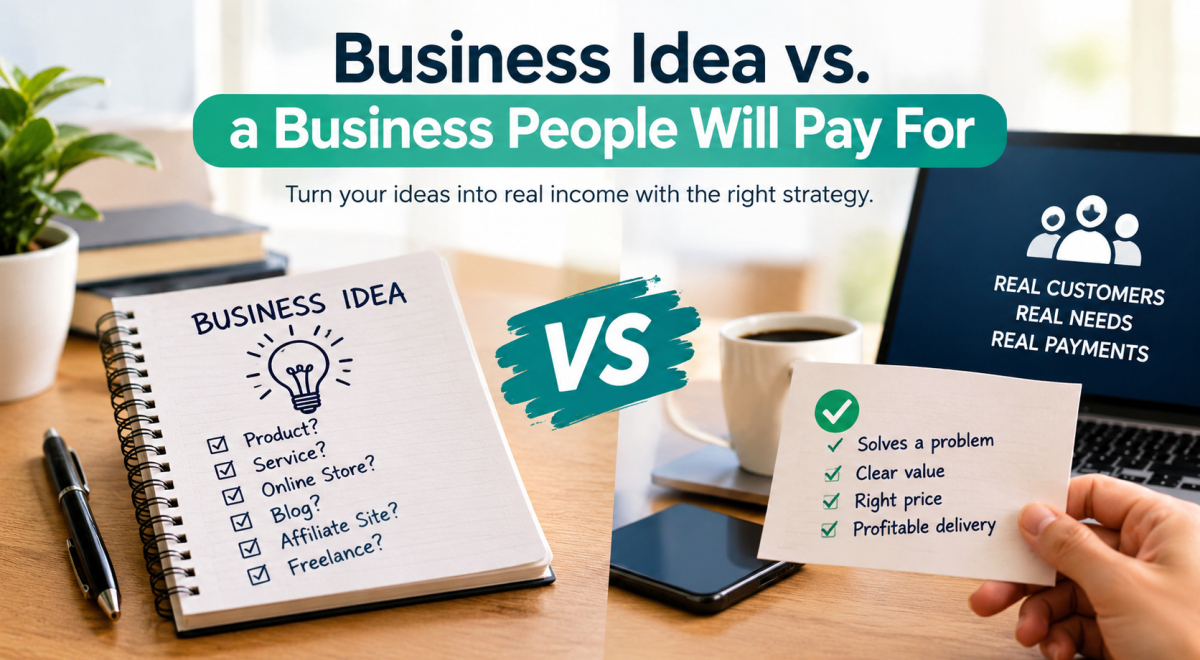
Business Idea vs. a Business People Will Pay For
The difference between a business idea and a business people will pay for
Most people who think about starting a business have the same moment. You spot something you could sell, your head fills with plans, and for a day or two it feels like you’ve already started. Maybe it’s an online store, printable budgeting planners, an affiliate site, or a service you could offer on the side.
But an idea that sounds good doesn’t cover anyone’s rent. To make money you need people who have a problem, a reason to believe you can fix it, and a price that works for both sides. Until you’ve seen evidence that people will actually pay, you have an idea, not a business.
This gap catches people out all the time. They spend three months on a website, a logo, an Instagram account, and a first batch of stock, then find out nobody wants to buy. Planning isn’t the mistake. Skipping the testing is.
This guide covers what separates the two, how to tell whether real demand exists, and how to check your idea cheaply before you put serious time or money into it.
1. What is a business idea?
It’s a product, service, or way of earning money that you think could bring in revenue. Most start with something you noticed, a skill you have, or an annoyance you’d like to fix. Say the café down the road posts blurry, mismatched photos on Instagram, and you figure you could design clean posts for small businesses at a low price.
Other ideas of the same kind: a printable budgeting planner, a personal finance blog that earns from ads and affiliate links, website design for local shops, handmade candles sold online, a beginner’s course in a skill you’ve picked up, or bookkeeping help for freelancers.
Any of these could become a business. “Could” is the important word. You might love making planners and still find nobody wants yours. Small businesses might need better posts but have no budget for a designer. Readers might enjoy your blog and never click an ad.
An idea tells you what you could sell. It doesn’t tell you whether anyone wants it, can afford it, or would pick it over what they already use. So the first job isn’t building the finished product. It’s learning about the people you’d be selling to.
2. What is a business people will pay for?
It’s an offer that a specific group of customers values enough to buy at a price they accept. Four things have to line up.
It solves a problem customer actually have
The problem doesn’t have to be dramatic. Saving ten minutes, avoiding an annoying chore, or not repeating an expensive mistake can all be enough. It does have to matter enough that someone does something about it.
Take social media posts. A bakery owner who gets most customers through word of mouth might like prettier posts but never think of them as a priority. A gym owner who has no time to post, knows her competitors are posting daily, and feels she’s losing sign-ups is a much better prospect. Both have the “problem.” Only one cares enough to spend money on it.
Customers understand what they’re getting
Compare these two descriptions:
- I provide digital marketing services.
- I help small online stores get a month of social media posts without hiring a full-time designer.
The second names who it’s for, what they get, and why it’s useful. It still needs testing, but a stranger can tell in five seconds whether it’s meant for them.
They’re willing and able to pay
Interest isn’t demand. Someone can love your product and have no budget. Someone else can have the money and prefer the tool they already use. A third person might buy only if you charge half of what you need to charge.
You need an offer, a customer, and a price that fit together.
You can deliver without losing money
Even when people buy, the business can fail if delivery costs too much. If you sell a $15 digital planner, and each sale costs you a small payment fee and the odd support email, that can work. If you spend two hours personalizing every planner, the same $15 pays you badly.
So the question isn’t just “will people pay?” It’s whether enough people will pay a price that covers delivery, the cost of finding customers, and running the business, with something left over for your time. The U.S. Small Business Administration’s market research guidance suggests looking at demand, market size, customer characteristics, competition, and pricing when you assess an opportunity.
3. Side by side
Here’s how the assumptions behind an idea compare with the evidence behind a real business.
| Area | Business idea | Business people will pay for |
| Customer | A broad audience you hope to reach | A defined group with a relevant need |
| Problem | One you believe exists | One customers have confirmed |
| Product | Something you want to make | A solution customers understand and value |
| Demand | Likes, opinions, your own hunch | Actions: purchase attempts, orders, sales |
| Pricing | A guess | A price tested against interest and your costs |
| Competition | Businesses you’ve noticed | What customers use today, and why |
| Revenue | An estimate of possible earnings | Real transactions or credible commitments |
| Costs | Expenses you expect | Costs measured under realistic conditions |
| Next step | Build everything and hope | Test the riskiest assumption first |
You don’t need every row filled in before your first sale. Early on, uncertainty is normal. The aim is to swap your scariest assumptions for evidence, then keep learning once customers start using what you’ve made.
One sale is encouraging, but it doesn’t prove you can get steady demand or make a profit. And zero sales at the start doesn’t mean the idea is dead. The audience, offer, price, or way you’re selling may just need work.
4. Why decent ideas still fail
An idea can make complete sense and still go nowhere. These five mistakes cause most of it.
Mistake 1: Building before you understand the customer
People tend to start with the thing they want to make. Someone into personal finance might spend six weeks building a budgeting app without checking whether their audience needs another app, prefers a spreadsheet, or already loves something like YNAB.
They answered “what do I want to build?” and skipped “what do these people struggle with?” Look at the customer’s habits, frustrations, and current workarounds first.
Mistake 2: Mistaking compliments for demand
Friends will tell you it’s a great idea. Strangers will like your announcement post. A potential customer might say, “Yeah, I’d totally use that.”
All of that feels good, and almost none of it predicts a sale. People are polite, they like a chat, and they like the concept without ever planning to pay.
Instead of asking whether they like your idea, ask how they handle the problem now, what they’ve tried, and whether they’ve ever paid for a fix. Then see if they’ll take a real step: ask for a quote, place an order, hand over money.
Mistake 3: Aiming at everyone
A product for everybody gives nobody a reason to pick it. A budgeting planner “for all adults” has to serve students, parents, freelancers, and people paying off debt, whose money problems look nothing alike.
Start with something like a budgeting planner for freelancers with irregular income. That one choice shapes the design, the wording, the price, and where you look for customers. You can widen the net later if the evidence supports it.
Mistake 4: Setting prices without doing the math
A very low price can bring in attention and leave you with nothing after costs. A high price can be fair for a good service and still be hard to justify if customers can’t see why you beat the cheaper option.
Work out your costs, look at what alternatives charge, and test what people will pay. Also keep in mind that “will they pay this?” and “do I make money at this price?” are different questions. A customer can happily accept your price while you lose money on every order.
Mistake 5: Assuming a big market guarantees sales
Thousands of people might want what you’re selling, and you might still have no affordable way to reach them. You need a realistic route: local relationships, search traffic, social media, direct outreach, a partnership, or an existing marketplace.
So the question isn’t only how many people might want it. It’s how you’ll find the right ones and turn enough of them into buyers. That’s why the SBA’s guidance puts competitors, customer behavior, pricing, and access to the target market alongside audience size.
5. How to test an idea before you spend much
You don’t need a finished product, an ad budget, or a polished website. You need a clear guess about what’s true and a cheap way to see whether people’s behavior backs it up.
Step 1: Pick one specific customer group

Describe the person or organization most likely to need what you’re offering. “People who want to save money” is too broad. “Young professionals who run out of cash a week before payday” is something you can go and find.
Ask yourself who has the problem, when it hits, what makes it annoying or costly, how they cope now, and who would pay most readily for something better. You aren’t ruling out everyone else forever. You’re choosing where to look first.
Step 2: Study the problem before pitching your solution
Talk to people in that group about what’s happened to them. Good questions:
- How do you handle this now?
- What’s the most annoying part?
- How often does it come up?
- Have you tried any products or services for it? What did you like or hate?
- Have you ever spent money on it?
Stick to the past. “Would you buy a budgeting planner?” gets a polite yes. “How do you track your spending now, and what happens when you fall behind?” gets you the real story and shows whether they’ve ever tried to fix it.
Interviews help you find needs and sharpen the offer. They can’t tell you how many people will buy, so use what you learn to design an actual test.
Step 3: Look at what people use today
Your competition isn’t only businesses selling the same thing. Your customer might use a spreadsheet, a free app, a sticky note on the fridge, or a friend who’s good with numbers.
Find out what people do now, what it costs them, what it does well, where it falls short, and why they chose it. You don’t have to invent something new. You can win by serving one group better, being more convenient, offering better support, or getting a clearer result. But the difference has to matter to the customer, not just to you.
Step 4: Build the smallest useful offer
Once you understand the problem, make a basic version of the solution. What that looks like depends on the business:
| Business | A practical first test |
| Graphic design service | Offer one clearly defined paid package to a handful of clients |
| Digital planner | Show sample pages and sell a limited first release |
| Online course | Run a paid workshop on one topic before recording a full course |
| Handmade products | Make a small batch and offer it to people who’d want it |
| Consulting | Sell a paid intro session on one specific problem |
| Online store | Test a few products instead of buying a lot of stock |
The point is to find out whether people value the offer without taking on big costs. Don’t promise features, deadlines, or results you can’t deliver. If you take payment in advance, spell out the terms and make sure you can fulfill the order or refund it.
Step 5: See whether people pay
This is where you move past interest. Depending on the business, you could run a paid pilot, take honest preorders, publish a product page with a real price, or invite qualified people to request a paid service.
Then watch what they do. Say you want to sell a $12 digital planner. You make a sample, explain what’s inside, and show the price to your target audience. Count how many visitors buy, how many ask questions and leave, and which objections keep coming up.
If people show interest and don’t buy, find out why. Maybe the product is unclear, the price feels high for this audience, the page doesn’t look trustworthy, or the problem just isn’t painful enough. A purchase is much stronger evidence than a compliment, and repeat purchases from your intended audience tell you more still.
If the product isn’t ready yet, say so. A waitlist or a mock checkout can measure interest, but you shouldn’t present either as a finished sale.
Step 6: Check that the numbers work

Here’s a hypothetical. You sell a planner for $12, and payment fees and other per-sale costs add up to $2. That leaves $10 per sale before fixed costs and your own time.
If your fixed costs are $100 a month, you need 10 sales to cover them, assuming those are the only costs.
They almost never are. That figure leaves out the time you spent making the planner, support emails, taxes, and anything else you forgot. If you put 40 hours into the product and sell a few copies, it might not be worth your time even though every sale is technically profitable.
So look at the economics and the effort together. For a service, count the hours each project takes. For physical goods, count production, packaging, shipping, returns, and stock that doesn’t sell. For affiliate sites, count the writing, the slow work of building an audience, and the fact that commissions are unpredictable. The idea gets convincing when both demand and delivery look workable.
Step 7: Decide what the results mean
After testing, pick your next move based on what you saw.
- Keep going if your target audience is buying, the offer seems useful, and the numbers could work.
- Fix the offer if customers get the problem but keep hitting the same obstacle, like confusing features, awkward delivery, or a price that doesn’t match the value.
- Change the customer if one group shrugs and your research points to another group that has the problem more often or has more reason to pay.
- Stop if several well-run tests show little demand, people won’t pay a workable price, or delivery costs sink the business.
Don’t tear everything up after one bad result. First ask whether you reached the right people, explained the offer clearly, and gave them a fair chance to buy.
There’s no magic number of interviews, visitors, or sales that proves an idea. How much evidence you need depends on the price, the market, how long people take to decide, and how expensive it would be to be wrong. What matters is that your next decision rests on what you learned and not on how attached you are to the original idea. Strategyzer’s guidance on testing business models and willingness to pay takes the same approach.
6. A worked example: from idea to paid offer
Here’s a hypothetical. Someone wants to sell budgeting templates online. The starting idea is simple: make nice-looking spreadsheets and sell them.
Before building a whole catalog, she talks to people who might use one. Several freelancers tell her the same things. Their income swings from month to month, their business and personal spending get tangled, and a big bill always seems to land right after a slow stretch.
So she narrows the plan to one product: a budgeting spreadsheet for freelancers with unpredictable income. Here’s how the process could go.
| Stage | What she does | What she learns |
| Initial idea | Plans to make budgeting spreadsheets | The concept is possible, but demand is a guess |
| Customer research | Talks to freelancers about money | Which problems come up often and how people cope now |
| Offer | Builds one spreadsheet for irregular income | Whether it speaks to a specific problem |
| Demand test | Shows the product and price to likely buyers | Whether anyone takes a real step toward buying |
| First sales | Sells to the interested people | Whether some will actually pay |
| Improvement | Reads feedback and reviews sales | What to change in features, price, or explanation |
| Evaluation | Adds up costs, sales, and hours | Whether this could become a sustainable business |
Now suppose she expected buyers to want dozens of designs. Instead, the first few customers mostly care about one thing: a simple number that tells them how much they can safely spend after upcoming bills. That feedback changes the product. She stops drawing new layouts and spends her time making that one feature work really well.
The lesson is that your first version is a hypothesis, not something you have to defend. Validation exists to show you what people value, even when it isn’t what you expected.
To be clear, this example is made up. It shows how the decision-making works. It isn’t a real success story, and it doesn’t promise you’ll get sales.
7. Is your idea ready to launch?
You don’t need perfect information. You need enough evidence to justify the next step up in spending. Before you commit real money or time, run through this checklist.
Customer demand
- I can describe my target customer specifically.
- I have evidence the problem exists.
- I know how customers solve it today.
- I’ve talked to potential customers or watched how they behave.
- I’ve tested whether people will pay for my offer.
Product and pricing
- My offer solves a clear problem or gives a real benefit.
- Customers can tell what they’d be getting.
- My price has a reasonable basis.
- I know what objections stop people from buying.
- I can deliver reliably.
Business viability
- I’ve estimated startup and running costs.
- I know what each sale costs me.
- I have a practical way to reach customers.
- I’ve looked at competitors and alternatives.
- I know what evidence would make me change course or stop.
If you can’t tick every box, that doesn’t make the idea bad. It means you’ve found your next questions.
Maybe customers clearly want your service, but you can’t find an affordable way to reach them. Then your next experiment should be about getting customers, not adding features. Or maybe the product looks promising and you have no idea what to charge. Test pricing before you order a big batch or pay for a launch. Either way, your spending follows what you’ve learned.
8. Common Mistakes to Avoid When Validating a Business Idea
Even people who take research seriously can read their results wrong. Watch for these.
Relying on friends and family: They want you to succeed, so their opinions skew kind. They can still be useful, but they probably aren’t your customers. Get feedback from people who have the problem and might realistically pay to solve it.
Giving the product away and assuming they’ll buy later: Free users are good at spotting usability problems. They behave differently from paying customers, though, so test willingness to pay separately.
Changing price or offer without keeping notes: If you alter three things at once, you can’t tell which one moved the results. For each test, write down the offer, price, audience, and outcome.
Spending on branding too early: A good logo and a clean website help a business, but they can’t rescue an offer nobody wants. Say what you need to say, and test it.
Quitting after one flop: A weak result might come from bad targeting, a confusing message, low trust, or a clunky checkout. Look for the likely cause before you write off the whole idea.
Ignoring your own capacity: A service can sell well and still demand more hours than you have. A physical product can bring in orders and then bury you in stock and shipping problems. Demand matters, and so does your ability to meet it.
Good validation asks more than “can this attract buyers?” It asks whether you can keep serving those buyers in a way that makes financial and practical sense.
9. How this applies to online businesses and side hustles
Starting a website or social account is easy, which is exactly why this matters for online businesses. The hard part is having an offer and reaching people with a reason to buy.
Affiliate marketing
Say you want to publish product reviews and earn commissions. Before you write fifty articles, find out whether a specific audience needs help choosing products, what questions they ask before buying, and whether decent products and affiliate programs exist for them.
A useful site helps readers decide. It doesn’t just stack up promotional posts. Also count the time it takes to write, get visitors, and maintain the site, and follow the advertising and affiliate disclosure rules that apply to you. Traffic alone doesn’t guarantee commissions.
Digital products
Ebooks, templates, and courses should start with one specific customer need. Test a single focused product with a clear outcome before building a whole range. Let customer questions and buying behavior tell you whether to improve it or make related products.
Digital delivery makes extra orders cheap to fulfill. It doesn’t remove marketing, support, payment fees, or the hours it takes to make something good.
Freelancing
If you plan to offer writing, design, web development, or virtual assistance, test demand by pitching a clearly defined service. “Digital services” tells a client nothing. “Five social media graphics a month for small shops” or “a fixed package of website updates” tells them exactly what they’d buy.
Your first paid projects also show you how long delivery really takes, what clients expect, and whether your rates make sense.
Ecommerce
Skip the big inventory order. Start with a small selection and find out what buyers like about it. Look at shipping costs, supplier reliability, returns, the cost of winning each customer, and what competitors charge.
A product can get plenty of attention and still lose money if buyers can get the same thing cheaper or if fulfillment eats the margin.
In every case the order is the same: test the customer’s problem, test your offer, then check the economics.
Frequently asked questions
1. What’s the main difference between a business idea and a real business opportunity?
An idea is a product, service, or way of earning that you believe could work. An opportunity has evidence behind it: a customer need, a market you can reach, and a believable way to bring in revenue. The idea gets more credible as you show that customers will pay and that you can serve them at a cost you can sustain.
2. How do I know if people will pay for my idea?
Start by learning how potential customers handle the problem today. Then put a specific offer with a clear price in front of them and see what they do. Paid pilots, first sales, and honest preorders all count as useful evidence. Surveys and interviews can explain why people prefer what they prefer, but saying they’re interested doesn’t establish demand.
3. Do I need money to validate an idea?
Not necessarily. Customer interviews, competitor research, simple prototypes, and direct conversations with buyers cost little or nothing. Some tests do cost money, though. A physical product might need a sample or a small production run. The goal is to learn as much as you reasonably can before the bigger spending starts, not to pretend every business can be tested for free.
4. How many customers do I need?
There’s no universal number. A few purchases show that some people will pay, but they don’t prove steady demand. A business serving a small specialist market needs different evidence from one selling cheap products to a huge audience. Think about market size, price, how long people take to decide, and how costly a wrong call would be. Look for a pattern that repeats, not one encouraging result.
5. What if people like my idea but nobody buys?
Find out why. It could be the price, the offer, the audience, trust, or the way you describe the product. It could also be that people recognize the problem and don’t care enough to pay for a fix. Ask potential customers about their objections, and change one thing at a time. If several tests keep showing weak demand, change the offer or move on to another idea.
6. Should I start if there’s already competition?
Yes. Competition doesn’t automatically rule an idea out, and it often shows that customers already spend money in that market. You do need to understand what those customers value and why they’d pick you. You might serve a narrower group, be more convenient, offer better support, or fix something the existing options handle badly. The difference has to be big enough to change a buying decision.
7. When should I stop testing and launch?
Consider launching a limited version once you have signs of customer interest, a believable path to first sales, and a decent grasp of your costs and delivery needs. You don’t have to remove every uncertainty. Keep your first commitment small and keep measuring after launch. If the product needs heavy investment, inventory, regulatory approval, or specialized infrastructure, you’ll probably want more validation first.
Conclusion: build what customers value, not just what you imagine
A promising idea is a fine place to start, but it’s only that. The real work is understanding customers, finding a problem worth solving, making a useful offer, and learning whether people will pay a price that supports the business.
You don’t have to predict everything correctly in advance. You have to test your assumptions, pay attention to what customers actually do, and decide sensibly where your money and time go.
So start small. Talk to the people you want to serve. Look at what they use now. Test a clear offer and work out what it costs to deliver.
If the evidence is good, improve the product and grow carefully. If it isn’t, use what you learned to adjust the offer or rethink the opportunity.
The goal isn’t to fall in love with your idea. It’s to find a need that’s real and build something people are willing to pay for.