
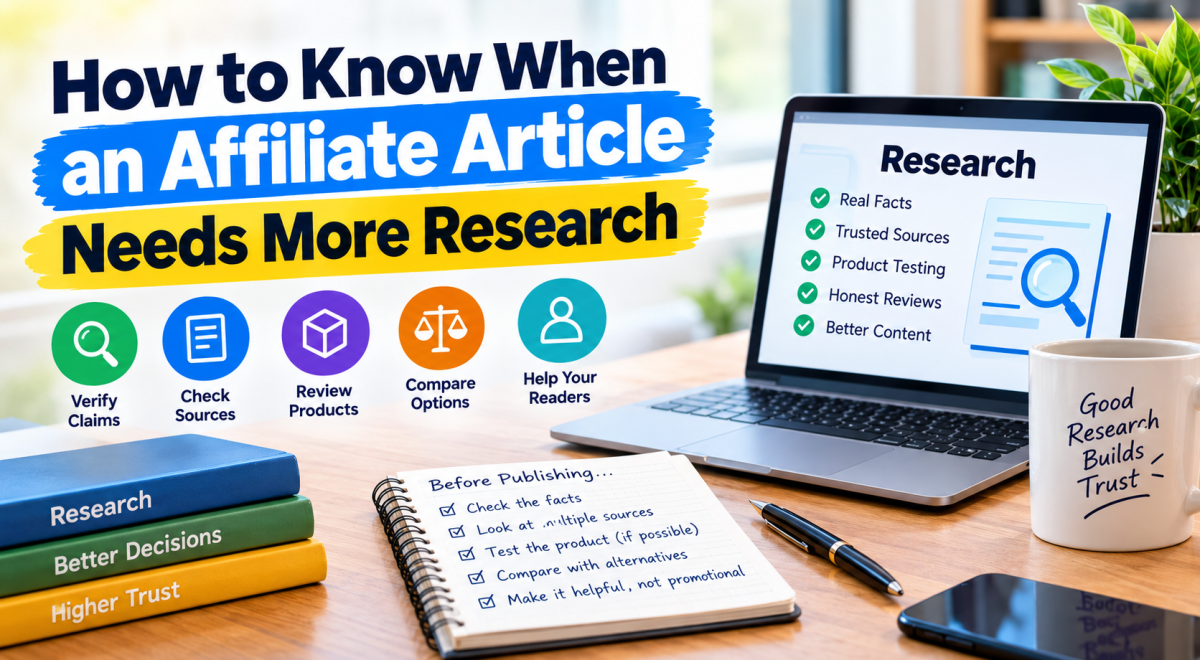
How to know when an affiliate article needs more research
An affiliate article can look finished and still leave readers stuck. It has keywords, a tidy list of recommendations, maybe even a comparison table. But the writer calls a product “affordable” without showing a single price, or calls a tool “beginner-friendly” without ever watching a beginner use it. The recommendation sounds confident, and the writer has never opened the product.
That’s a research gap, and readers notice it faster than you’d think.
Good affiliate content answers the questions a buyer would ask a knowledgeable friend. What does it do? Who is it for? What does it cost? Where does it fall short? How does it stack up against the alternatives? Research is how you answer those questions with evidence instead of guesses or a company’s own sales copy.
Google’s helpful content guidance asks for accuracy, originality, and first-hand knowledge where it applies. It also says there’s no ideal word count that guarantees rankings, so padding won’t rescue a thin article.
Below are six signs your article needs more work, plus what to do about each one.
1. You can’t verify the claims you’re making
The clearest warning sign is a sentence that sounds like a fact but has nothing behind it. Take these three:
- This is the best budgeting app for beginners.
- This software saves businesses hundreds of dollars every month.
- This affiliate program offers the highest commissions in the industry.
The first needs stated criteria and real comparisons. The second needs evidence for the savings. The third needs current commission rates for a defined set of competing programs.
Before you publish a claim, ask whether it’s a fact, an opinion, or a prediction. Then ask what supports it, and whether a reader could check that support themselves.
For facts, go to primary sources: official pricing pages, product documentation, published research, regulator guidance. Independent reviews and respected specialist publications add context.
If you can’t back a claim up, cut it, soften it, or dig further. Often the better move is a more precise sentence. Instead of calling a tool “the cheapest option available,” say that its entry-level plan costs less than the three alternatives you compared, and note the date you checked.
2. You haven’t looked closely enough at the product

A product description lifted from a sales page isn’t research. Readers want to know how the thing behaves once they’re using it, and whether it fits their situation.
This matters most for software comparisons, hosting recommendations, financial tools, and business services, where a wrong choice costs real money.
If you can, use the product yourself. Run through the setup, try the main features, hit the limits, and write down anything that could change a buyer’s mind.
If you can’t get access, you can still write something useful, as long as you’re upfront about how you did the research. Read the documentation, watch the official demos, compare independent sources, and don’t pass off someone else’s experience as your own.
Say you’re writing about email marketing software. The feature list on the homepage won’t tell you much. You’ll want to know:
- Whether the cheapest plan includes automation
- How subscriber and sending limits work
- Which features sit behind an upgrade
- Whether you can export your contacts if you leave
- What support looks like on each plan
- Whether any key functions cost extra
Details like these show whether a tool that looks cheap will actually do the job. Google’s product review guidance points the same way: original analysis, evidence that you did the research, real comparisons, and honest strengths and weaknesses.
3. All your sources come from one company
A company’s website is a fine place to start. Nobody knows the current plans, integrations, and policies better than the company itself. But promotional pages rarely dwell on drawbacks, rivals, or the problems customers run into.
If your whole article rests on marketing material, the research probably isn’t done.
Match the source to the claim:
| Information you need | Useful sources |
| Current pricing and plan limits | Official pricing pages and plan documentation |
| Product features | Official documentation and demos |
| Independent comparisons | Reputable specialist publications and documented tests |
| Customer difficulties | Verified user feedback, support forums, recurring complaints |
| Legal or compliance requirements | Government agencies and official regulations |
| Long-term performance | Repeated testing or credible long-term evidence |
Each type of source has a job and a limit. One customer review can point to a usability problem, but it doesn’t prove everyone will hit it. A product’s documentation can prove a feature exists. It can’t tell you whether the feature is any good.
Cross-check anything important against evidence that suits the question.
4. The pricing or product details may be out of date
Affiliate articles go stale quickly. Prices change, features move between tiers, commission structures get rewritten, and free plans disappear.
A review from last year might still praise a free plan that’s gone. Or it might recommend a feature that now requires the pricier subscription.
Before you publish or update, check anything that could sway a purchase. Start on the official site and confirm the current price, billing period, trial terms, refund policy, and any restrictions that affect your recommendation. If it helps readers judge how current the information is, put the date you checked.
Watch for words like “free,” “unlimited,” “lifetime,” and “guaranteed.” They often come with conditions that change what the offer really means.
You don’t need to re-verify every minor detail each time you touch an article. Focus on the facts that could change a reader’s decision, and set a review schedule for products that change often.
5. You recommend products without saying who they’re for
A list of products isn’t a comparison.
Picture an article with three website builders. All three are called easy, affordable, and good for small businesses. The reader still can’t tell which one suits a simple portfolio, which can handle a growing online store, or which connects to the tools they already use.
That usually means the research stopped too early and the article has no framework for comparing.
Start from the reader’s actual problem, then pick criteria that fit. For most products, these are a good base:
- Total cost over the first year
- Essential features and plan restrictions
- How easy setup is for the intended user
- Compatibility with tools they already use
- Customer support and documentation
- Drawbacks and missing features
- Fit for different budgets and business sizes
Then judge every product against the same list.
A beginner on a tight budget probably wants simple setup and a low starting price. A growing business needs automation, integrations, and room to scale. The more expensive option isn’t automatically better for either of them.
Your research should end in a recommendation you can defend, not a ranking built to attract clicks.
6. You can’t explain the product’s downsides
When every product in an article sounds great, readers start to wonder what’s being left out.
Every product has limits, even the good ones. Some have a steep learning curve. Others have a stripped-down entry plan, few integrations, or costly upgrades. Some are packed with features a beginner will never touch.
Research the drawbacks that matter to your intended reader. Look in the terms of service, pricing pages, technical documentation, independent tests, and the complaints that keep coming up in user feedback. When you can, separate a confirmed limitation from a matter of taste.
A tool with fewer advanced features than its competitors is a real problem for a power user and a non-issue for someone who just needs the basics. Say that, rather than labeling the product good or bad with no context.
A useful recommendation answers two questions: what does the reader gain, and what do they give up?
7. The article has numbers with no clear source

Statistics make an affiliate article look authoritative. Unsupported ones do the opposite once a reader starts asking where they came from.
Be most suspicious of claims about average savings, conversion rates, typical earnings, product performance, customer satisfaction, and market growth. They deserve more digging than an ordinary product description does.
For every number that matters, run through five checks:
- Original source: Who collected or published the data?
- Date: When did it come out, and does it still apply?
- Method: How was the figure calculated?
- Scope: Which people, products, markets, or time periods does it cover?
- Meaning: Does it actually support the point you’re making?
Say an article tells readers a beginner can earn $5,000 a month from affiliate marketing. Maybe one person did report that. It still tells you nothing about what beginners typically earn or how long it took that person to get there.
Don’t turn an exceptional result into a general expectation.
If you can’t find reliable evidence, drop the number, or explain plainly what’s known and what isn’t. A careful explanation helps readers more than a precise-looking figure they can’t check.
8. The article repeats other websites instead of adding something
Research doesn’t mean opening five articles and rewording their sentences. The result sounds complete, but it adds nothing a reader couldn’t find in the originals.
Google’s spam policies call out thin affiliation: affiliate pages that offer little beyond copied merchant descriptions or standard promotional material.
To test your own draft, put it next to the sources you used and ask what a reader would learn from your article that they wouldn’t learn by visiting those sources directly.
Here are some things that add real value:
- A comparison built on the same criteria for every product
- A worked example with the assumptions spelled out
- A breakdown of which features matter at different budgets
- An honest account of how you tested the product
- A look at hidden costs or plan restrictions
- A decision checklist the reader can actually use
- A note on when a competitor would be the better pick
You don’t need to invent a new fact to be original. Original value can come from reading reliable evidence carefully and using it to solve one specific problem.
If your draft contains only familiar claims and general advice, go find out what readers are still asking before you publish.
9. Important questions are still unanswered
A draft can be accurate line by line and still leave out what a buyer needs.
Reread it as someone about to spend money. What would they want to know first?
For software, that might be compatibility, pricing, cancellation terms, or a missing feature. For an affiliate marketing course, it could be how much experience you need going in, what the curriculum covers, how refunds work, and how the promised results compare with what students typically get.
Write down the handful of questions your target reader is most likely to ask. Then check each one. Is it answered clearly, covered by a useful link, or flagged as something you couldn’t confirm?
You don’t have to cover everything. Stick to what affects the reader’s choice, safety, budget, or expectations.
If someone would have to leave your page to answer an obvious buying question, the article probably isn’t ready.
10. Your affiliate relationship isn’t clearly disclosed
How you present your relationship with the products you recommend is part of research quality too.
If you earn commissions from your links, readers should know that before they rely on your advice. The U.S. Federal Trade Commission says disclosures should be clear and conspicuous, and the wording should explain the financial connection. One placed near the recommendation or link works better than one buried on a separate page.
A simple version could read:
“Some links in this article are affiliate links. If you buy through them, we may earn a commission at no extra cost to you.”
Make sure the wording matches your actual arrangements, and check the rules that apply to your audience and location.
Also look at whether commissions shaped your rankings. A higher payout isn’t a good reason to put a product ahead of one that fits the reader better.
Disclosure doesn’t replace research. It just tells readers where you’re coming from.
A checklist to run before you publish
Use this during your final edit:
- I verified the main factual claims with suitable sources.
- I checked current prices, plan details, and restrictions.
- I separated what I tested myself from what I learned from other sources.
- I explained the main benefits and drawbacks.
- I compared products using the same relevant criteria.
- I checked every statistic and left out unsupported earnings claims.
- I added analysis beyond the merchant’s own descriptions.
- I answered the main questions a buyer would ask.
- I included a clear affiliate disclosure where it applies.
- I checked links, spelling, headings, and overall clarity.
Not every article needs the same depth. A general explainer on how affiliate marketing works needs different evidence than a detailed comparison of financial software. Scale your effort to how complex the claims are and how much damage a mistake could do.
Publish, revise, or research more?
Once you’ve worked through the checklist, put the article in one of three buckets.
Ready to publish.
The central claims are supported, the important details are current, your recommendations have a clear basis, and readers can see the main trade-offs.
Needs revision.
The research holds up, but something is off in the writing or presentation: murky explanations, weak comparisons, a missing disclosure, broken links, or a few claims with nothing behind them.
Needs more research.
You can’t verify a major claim, the product’s current terms are unclear, a recommendation has no evidence, or the article promises results you can’t back up.
Claims about earnings, financial outcomes, safety, or legal compliance belong in that last bucket until you’ve verified them. A polished article around them doesn’t make them safe to publish.
This sorting also saves time. You can fix a missing explanation by editing, but rewording will never close a real evidence gap.
Frequently asked questions
How much research does an affiliate article need?
There’s no set number of sources or hours. It depends on the subject, the claims you’re making, and how much the information could affect a reader’s decision. A detailed product comparison needs more evidence than a basic intro to a familiar topic.
Do I need to test every product I recommend?
Testing matters most when you’re writing a hands-on review or making claims about real-world performance. If you can’t test, lean on reliable documentation and independent evidence, explain how you researched it, and don’t suggest you used the product yourself.
How can I check whether an affiliate article is accurate?
Check the important claims against primary sources, cross-check anything significant, confirm current pricing and terms, and make sure the evidence supports your conclusions. Look hardest at numbers and at any statement about likely results.
Does longer content need more research?
Not automatically. A long article may need more evidence if it covers more claims, products, or scenarios, but length alone doesn’t make it better. Google doesn’t set a preferred word count for ranking, so aim for complete and useful rather than long.
Should I update an affiliate article after it’s published?
Yes, whenever something changes or you spot an error. Review prices, features, terms, links, and recommendations on a schedule that matches how fast the subject moves. Make real updates when they’re needed. Changing the publish date without improving the content doesn’t count.
Summary
Knowing when an affiliate article needs more research comes down to spotting the questions your evidence can’t answer yet. Unsupported claims, stale product details, one-sided comparisons, unexplained statistics, and gaps in purchasing information are all reasons to hold off.
Start with the claims readers care about most. Verify them, be upfront about where your evidence runs out, and base your recommendations on what different readers need, not on commission rates.
An article is ready when its key claims are backed up, its limits are clear, and a reader can make a better decision after reading it. If it isn’t there yet, more research will do more for you than another round of polishing.