

The affiliate content gap: how to find questions other websites ignore
Affiliate marketing is crowded with product roundups, “best tools” lists, and guides to making money online. Readers finish most of them with questions the writer never touched.
A software review walks through features but never says whether the free plan is enough for a beginner. A budgeting app comparison ranks five tools without saying which one copes with irregular income. A hosting guide praises speed and skips the renewal price that surprises new site owners a year later.
Those leftover questions are your opening.
An affiliate content gap is a question, worry, or decision that existing content doesn’t answer well. Spotting one lets you write a more useful article, fix an existing page, or take a familiar topic from an angle that fits your audience better.
Don’t hunt for something nobody has mentioned just to be different. Look for what readers still need after they’ve read everything already out there.
Here’s how to find those gaps and turn them into content.
What is an affiliate content gap?
Traditional SEO gap analysis finds keywords your competitors rank for and you don’t. Ahrefs, for one, can show those missing keywords and compare your site against rival domains. An affiliate content gap goes a step further and asks whether the existing answers are any good.
Four types show up most often.
1. Missing information
An article covers a topic but skips an important question. A guide to email marketing software might compare features and prices without saying whether a beginner can get by on the free plan. Answer that directly, limits included.
2. Incomplete explanations
Sometimes the answer exists but is too thin to act on. An article says a budgeting app supports multiple bank accounts. Someone who keeps household and business money separate needs to know whether those accounts can be organized independently. The value is in the practical detail, not in a new keyword.
3. Unaddressed audience needs
Two people can research the same product and need different things. A freelancer shopping for invoicing software cares about recurring invoices and payment reminders. A student running a small online shop cares about a free plan and a quick setup. A general comparison usually serves one of them and shortchanges the other. A focused article can speak to one group without claiming a single product wins for everybody.
4. Unresolved buying objections
Readers hesitate over limitations, hidden costs, the learning curve, or whether a product suits their situation. These matter most to affiliate publishers because they tend to come up right before a purchase. For example:
- Is this tool worth paying for if I only have a few customers?
- What happens to my data if I cancel?
- Can I use this without technical experience?
- Is the cheaper alternative good enough?
Not every question deserves its own article. Some fit better in a review, a comparison table, or an FAQ. What matters is finding the information that helps someone decide.
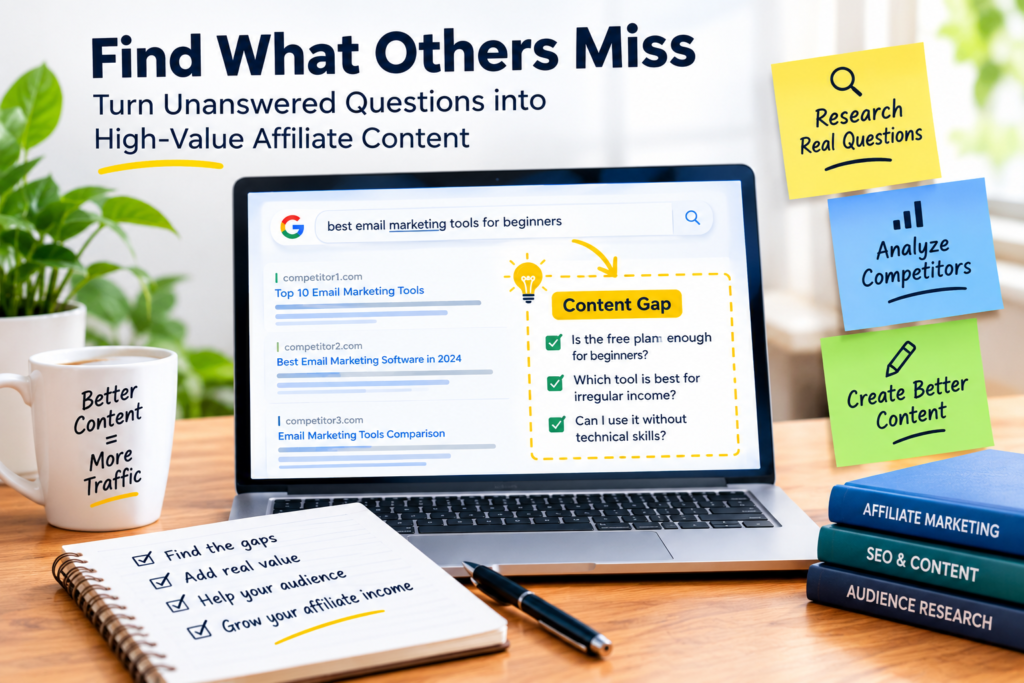
Why competitor research alone isn’t enough
Checking competitors is a fine start. The trap is assuming that whatever they publish is worth copying.
Say you search “best budgeting apps for beginners” and find several detailed comparisons. Each covers monthly price, features, and supported devices. If you publish another one with the same sections and a new title, readers get nothing they didn’t already have.
Look instead at which decisions those articles help with and which they leave hanging. Someone with irregular freelance income needs a different budgeting approach than someone with a fixed monthly salary. Someone who loves cash envelopes may wonder whether an app can handle that habit.
Those are angles to investigate, not proof that every competing article misses them. Read the actual results before you decide a gap exists.
Google’s people-first content guidance asks publishers for original analysis and real value instead of reworded versions of what’s already online. It gives you a simple test: would your article help readers understand something, or make a decision, that the pages you reviewed don’t support well? If the answer is no, keep researching.
How to find affiliate content gaps, step by step
This workflow is built for bloggers, affiliate marketers, and small niche sites.
Step 1: Pick one product category and one audience
Choose a subject you can honestly evaluate or explain. “Online business” is far too big. Try email marketing tools for solo business owners, or website hosting for first-time bloggers.
Then define the reader:
- Topic: email marketing software
- Audience: beginners building their first email list
- Constraints: small budget, little technical knowledge, a handful of subscribers
- Decision: which tool works now, and when upgrading makes sense
This gives your research a direction, and it lets you drop interesting questions that your readers don’t care about.
Step 2: Search Google with question-style phrases
Pair your category with words that signal doubt or a specific situation. Some patterns that work:
- Is [product] worth it for beginners?
- [Product] limitations
- [Product] free plan restrictions
- [Product A] vs [Product B] for [specific user]
- How to use [product] without [common requirement]
- Best [product category] for people with [constraint]
- [Product] alternatives for [specific need]
A suggested query isn’t proof of demand. These searches help you find questions and inspect the results. They don’t tell you search volume or how hard the keyword is to rank for.
Open the most relevant pages and note what they answer, what evidence they give, and what they skip. Look past the headings, too. An article may have no section called “Is the free plan enough?” and still answer it well inside its pricing discussion. You’re after a real information gap, not a missing heading.
Step 3: Read reviews and community discussions
Search results show how publishers frame a topic. Forums and reviews show how people describe their problems in their own words. Good places to look:
- Reddit communities in your niche
- Product reviews and user feedback
- Public support forums
- Q&A sites
- Comments on specialist blogs and tutorials
- Questions sent to your own site or business
Look for concerns that keep coming back, not one-off complaints. If several people discussing a project management tool ask how to organize personal projects without paying for team features, you may have an angle: how to judge that tool’s free plan for individual use.
Before you act on it, check the current features and pricing from reliable sources. A few comments don’t tell you how widespread a problem is, and community threads aren’t representative surveys. Use them to generate ideas, then confirm relevance, accuracy, and search intent.
Step 4: Compare the top-ranking pages side by side
Build a simple spreadsheet. List the main competing pages and score each one against the questions a reader needs answered.
| Question to investigate | What to look for |
| Does it say who the product suits? | Specific user types and realistic use cases |
| Does it discuss limitations? | Restrictions, exclusions, and trade-offs |
| Does it explain the total cost? | Fees, renewal prices, or upgrade requirements |
| Does it show how to get started? | Setup instructions and practical examples |
| Does it compare alternatives fairly? | Real differences and reasons to pick each option |
| Does it back up its claims? | Current documentation, testing, and credible evidence |
Mark each question as answered, partly answered, or unanswered.
This keeps you from mistaking a missing paragraph for a real gap, and it helps you decide whether to improve an existing page or write a new article.
If you use an SEO tool, a keyword gap report can add to this manual review by showing related searches that competing domains rank for. Ahrefs describes two kinds of gap: domain-level, where a competitor covers a topic you don’t, and page-level, where competing pages cover a subject more broadly than yours. Use the report to build a list of candidates, then judge each one by what it does for the reader.
Step 5: Find the questions your own content misses
Competitor research only gets you halfway. Your own site may already have articles that bring in visitors but leave their follow-up questions unanswered.
If you have Google Search Console, look at the queries tied to your pages. You’re hunting for searches where the reader clearly wants a more specific answer than your page gives.
Say your guide to starting an online store gets impressions for searches about selling products without holding inventory. If the article barely mentions fulfillment options, that’s a good reason to update it.
Comments, contact-form messages, and questions people ask after reading your content work the same way.
Before you create a new URL, check whether an existing article should be expanded instead. Two pages aimed at the same need often serve readers worse than one well-organized page.
Step 6: Turn each gap into a clear article angle
Once you’ve found a question, write it out as a sentence before you write a headline.
Suppose your broad topic is “best website builders,” and your research turns up beginners who want to sell a single digital product without running a complicated store. Your angle could be:
How to choose a website builder for selling one digital product
That’s tighter than yet another general list of website builders. It also tells you what the article has to cover: features, costs, setup requirements, payment options, and limitations.
A useful article brief answers five questions:
- Who is the reader?
- What decision or problem are they facing?
- What do the existing pages fail to explain well?
- What evidence or practical examples can you offer?
- What should the reader understand, or be able to do, after reading?
If you can’t answer the third one, you have a topic idea. You don’t have a confirmed content gap yet.

Step 7: Verify the gap before writing the full article
Before you spend hours writing, go back to the current search results and read the strongest competing pages again.
Check three things: whether your angle is genuinely under-served, whether the reader intent behind the search is consistent, and whether you can give a better-supported answer than what’s there.
If the gap depends on a product’s current price, an integration, or a free-plan restriction, confirm it in the official documentation or on the current product page. Write down the date you checked, since this kind of information changes often.
You may find that a competitor already answers the question well. That’s still useful research. You can narrow your angle, look for a different unresolved need, or decide the topic isn’t worth your time.
No process can guarantee a new article will rank. The point is to make better publishing decisions before you commit the hours.
How to decide which content gaps are worth pursuing
Finding unanswered questions is only half the job. Some are valuable to your audience but too broad to answer well. Others are easy to answer but have nothing to do with what your site is about.
Score each opportunity before it goes on your editorial calendar. Rate each factor from 1 to 3.
| Factor | 1 point | 2 points | 3 points |
| Audience relevance | Peripheral topic | Somewhat relevant | Directly relevant |
| Evidence of a gap | Weak or unconfirmed | Partly supported | Clearly shown |
| Affiliate relevance | No natural connection | Indirect connection | Helps readers evaluate a relevant product |
| Ability to answer well | Little evidence | Some useful evidence | Strong evidence and practical detail |
| Search opportunity | Poor fit or unclear intent | Plausible | Clear intent worth investigating |
The maximum is 15. As a rule of thumb, write the ones that score 11 to 15, dig further into 8 to 10, and rethink anything under 8.
Those cutoffs are a planning method I’m suggesting, not an established SEO formula. A low-volume question can still deserve an article if your audience cares about it a lot, and a popular topic can be a waste of your time.
Count the cost of making the content
Before you commit, ask whether the gap needs original testing, specialist knowledge, frequent updates, or information you can’t verify.
Comparing two free budgeting templates is simple. Comparing financial software integrations probably means hands-on testing and regular maintenance.
Pick a format that matches the evidence you have. If you haven’t tested a product, don’t call your research personal testing. You can still write a useful, clearly sourced comparison. Just explain what it’s based on and where it falls short.
How to turn a content gap into an affiliate article that helps readers
Finding the gap doesn’t make the finished article useful. The structure and evidence have to resolve the original question.
Here’s a hypothetical. You find that beginners researching email marketing tools want to know whether a free plan is enough for a small mailing list. Don’t write another generic list of the best email platforms. Build the article around that decision.
Open with the direct answer
Explain what determines whether a free plan is enough: subscriber limits, sending limits, automation features, branding restrictions, and whether the reader needs integrations. Don’t name a winner until you’ve checked each product’s current terms.
Compare products on criteria that matter
A comparison table should help readers decide, not just display features.
| Comparison point | Why readers need it |
| Free-plan limits | Shows whether the plan covers current needs |
| Automation | Shows whether essential workflows are included |
| Branding | Reveals restrictions that may affect a professional look |
| Upgrade requirements | Helps readers see when costs will rise |
| Ease of setup | Helps beginners judge the learning curve |
Check every entry against current official documentation. If a feature is missing or unclear, say so instead of guessing.
Say who should choose each option
A tool that suits someone sending one newsletter a month may fall apart for a business that relies on automated customer sequences. Lay out the trade-offs and say when an alternative makes more sense. This is where an affiliate article beats a feature list.
Give readers a next step
Help them apply what they’ve read. Suggest they estimate their expected subscriber count, list the automations they actually need, and check the upgrade price before picking a platform.
Affiliate links should support that decision, not interrupt it. If you recommend a product, explain why it fits the use case you described, and disclose the affiliate relationship plainly. Readers trust a recommendation more when they can see the reasoning, the limitations, and the possible costs.
Common mistakes when searching for affiliate content gaps
Chasing low keyword difficulty without checking intent
A keyword tool might show an appealing difficulty score. That doesn’t mean the search results are weak or that the topic will bring in the right audience.
Read the actual results. Work out whether searchers want a tutorial, a comparison, a product review, or a quick fact. Then ask whether your site can meet that need.
Treating every missing detail as a new article
If an existing guide already covers the subject, a new article may just overlap with it. Add a section when the missing information belongs in the existing page. Make a separate page when the question has its own purpose and deserves a full answer.
Trusting a single community comment
One complaint might point to a real problem. It might also come from an unusual setup or an outdated version of the product. Look for corroboration, check the documentation, and don’t stretch isolated opinions into broad claims.
Publishing without evidence
Don’t invent product limitations, pricing details, user experiences, or conversion results to make an article sound more authoritative. When you can’t test something directly, rely on credible documentation and keep verified facts separate from your own analysis. Google’s guidance stresses original value, accuracy, and transparent authorship.
Recommending a product too early
A question can be commercial without calling for a product pick right away. If readers first need to understand a concept, help them with that. Recommend something only when it fits the question and your evidence backs it up.
Ignoring questions after publication
Research doesn’t stop when the article goes live. Watch the relevant search queries, reader feedback, and changes to the products you cover. Update the article when the evidence or readers’ needs shift, and don’t change the publication date unless you’ve made a real improvement.
Frequently asked questions
What is an affiliate content gap?
It’s a question, concern, or decision that existing content doesn’t address well for a particular audience. The gap might be missing information, a weak explanation, an unaddressed use case, or an unresolved buying objection.
How do I find content gaps without paid SEO tools?
Start with Google searches and read the competing articles. Add community discussions, product documentation, and the questions readers send you. Google Search Console shows which queries bring people to your existing pages. Paid tools speed up keyword comparisons, but you don’t need one to start researching what your audience wants.
Are unanswered questions always low-competition keywords?
No. A question can be underserved in one way and still face tough competition from established sites. Search volume, ranking difficulty, and the quality of existing answers are separate things, so look at them together. An unanswered question isn’t automatically easy to rank for.
Should I create a new article or update an existing one?
Update when the missing information serves the same main search intent as the page you already have. Write a new article when the question is a distinct need that deserves a complete answer. Check your current pages first so you don’t publish overlapping content.
How many content gaps should I target each month?
There’s no ideal number. It depends on how much you can publish, how much research each piece needs, and how well you can keep your older content up to date. A small site often does better with a few well-researched articles than with a pile of thin pages.
Can finding content gaps increase affiliate income?
It can help you make content that fits readers’ questions and buying decisions, but revenue isn’t guaranteed. Results also depend on search visibility, audience trust, whether the product suits the reader, your affiliate terms, and the page experience. Track performance over time instead of assuming every gap will turn into sales.
lastly
The best affiliate content ideas often show up when you stop asking only which keywords competitors rank for and start asking what readers still don’t understand.
Look at the questions people ask. Compare the answers on competing sites, check the gaps in your own content, and confirm the missing information is useful to your audience. Then choose a fitting format, back your recommendations with evidence, and lay out the options clearly.
You don’t need a brand-new subject. You need a specific problem that existing pages don’t solve well, and the patience to solve it better.That makes for a stronger editorial strategy than publishing an article just because a keyword tool suggested it.